The first time I drove up to the Fairy Glen, I did it at half past seven on a September evening, mostly by accident. I had meant to be somewhere else. The light was going gold over Glen Conon, and I pulled into the little car park above Uig with about forty minutes of usable sun left.
Here is the thing nobody tells you. A large share of the people typing fairy glen Skye into a search box are not looking for this place at all. They want the Fairy Pools, which are forty miles away at the other end of the island, in a different landscape, on a different sort of day out. Sorting that out is the single most useful thing this guide can do for you, so let us clear it up first, and then I will tell you everything else — the road, the tariff, the scramble, and why you should walk past the stone spirals without adding to them.
Fairy Glen Skye: the short answer
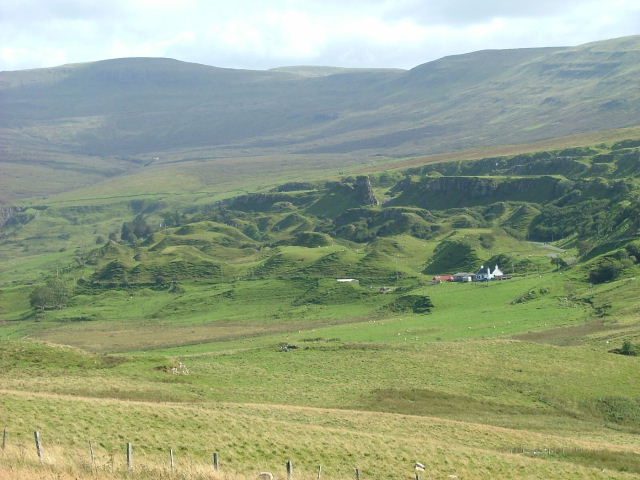
The Fairy Glen is a small area of grassy cones, terraces and lochans a mile and a half above Uig on Skye’s Trotternish peninsula, formed by an ancient landslip. It is free to enter, takes 30 to 60 minutes to wander, and has a small paid car park. It is not the Fairy Pools.
Fairy Glen Skye at a glance
| Detail | What to expect |
|---|---|
| Where | Balnaknock, above Uig, north-west Trotternish, Isle of Skye |
| Getting there | Turn off the A87 just south of Uig at the Sheader / Balnaknock sign, then 1.5 miles of single-track road |
| Drive time | About 30–35 minutes from Portree; 8–10 minutes from Uig pier |
| Parking | Small pay-and-display car park, around £2 for 2 hours and £3 for 4 hours at the time of writing, card or coins |
| Entry | Free; you pay only for the car |
| Time needed | 30 minutes for a quick loop, 60–90 if you climb Castle Ewen and linger |
| Terrain | Grass, mud, one steep worn path, plus an exposed scramble if you go to the top |
| Best light | Early morning or the last two hours before sunset; flat midday light kills it |
Fairy Glen or Fairy Pools? Skye’s three “fairy” places, sorted
Skye has three separate attractions with fairy in the name, and they are constantly confused with one another. I have watched a family arrive at the Fairy Glen car park in swimming costumes, which tells you how common the mix-up is.
The Fairy Glen, above Uig
Green cones, stepped terraces, a reedy lochan and a lump of rock called Castle Ewen. Dry land, no waterfalls, no swimming. It is a short, gentle wander rather than a walk, and it sits in the far north-west of the island on the Isle of Skye‘s Trotternish peninsula.
The Fairy Pools, Glenbrittle
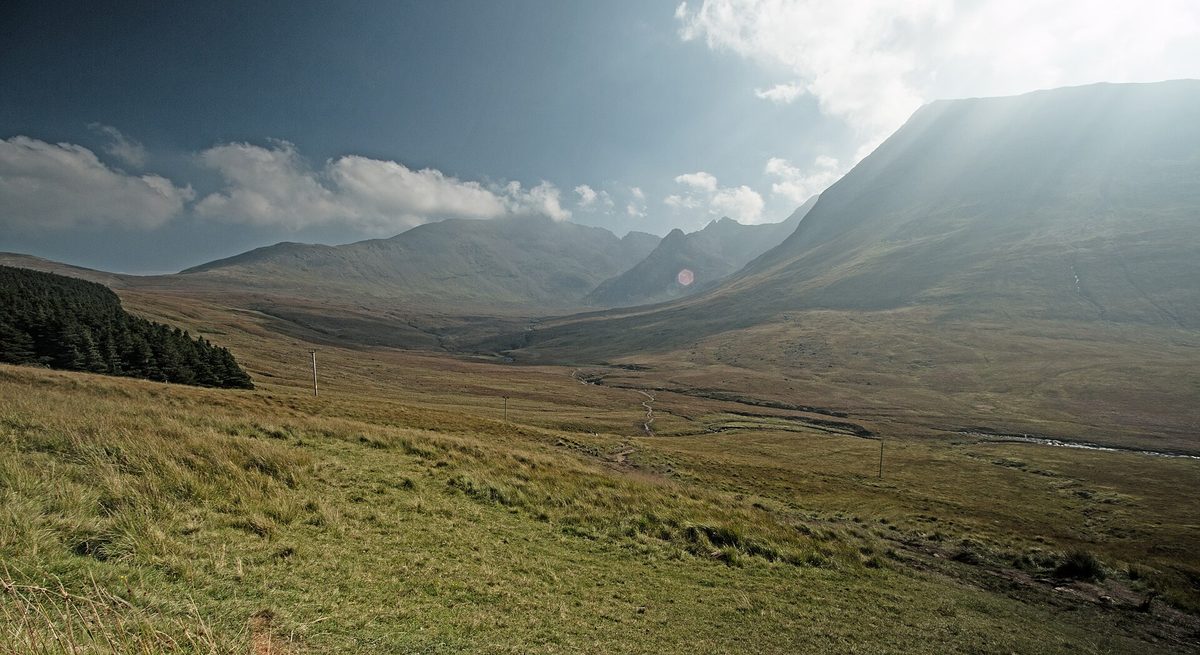
A chain of clear plunge pools and small waterfalls in a burn below the Black Cuillin, on the south-west side of the island. Proper cold-water swimming happens here. It is a 2.4km each-way walk on a stony path with a river crossing, a bigger car park with a bigger charge, and a genuinely different day — I have covered it in detail in the Fairy Pools walk guide.
The two are roughly 40 miles apart by road, which on Skye means an hour and a quarter to an hour and a half each way, via Portree and Carbost. You cannot casually do both in a spare afternoon. You can do both in one long day if you accept a lot of driving and start early, but I would rather split them across a two-night stay.
The Fairy Bridge, near Dunvegan
The third one, and the one that catches out anyone chasing folklore. Beul-ath nan Tri Allt sits at the junction of the A850 and the B886 north of Dunvegan, and it is connected to the Fairy Flag kept at Dunvegan Castle. There is nothing to see. It is a road junction with a bridge. Do not build a day around it.
| Fairy Glen | Fairy Pools | |
|---|---|---|
| Where | Uig, north Trotternish | Glenbrittle, south-west Skye |
| What it is | Landslip hillocks and terraces | Waterfalls and swimming pools |
| Walking | About 1km loop, 30–60 mins | 2.4km each way, 90 mins–2.5 hrs |
| Parking | Around £2–3, small car park | Around £8 per car, larger car park |
| Wet feet? | Only if it has rained | Guaranteed, and the river crossing floods |
| Best for | A 45-minute stop between other places | Half a day, ideally with a towel |
What the Fairy Glen actually is
Strip away the marketing and this is a piece of geology, and a good one.
A landslip in miniature
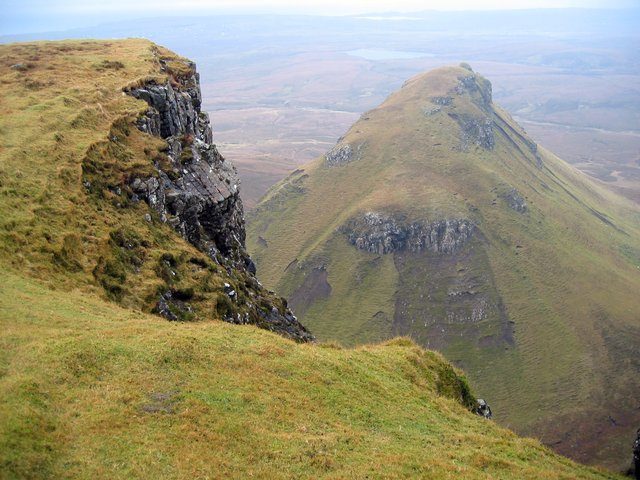
The whole Trotternish peninsula is built on the same unstable arrangement: thick sheets of basalt lava, poured out roughly 60 million years ago, sitting on top of much weaker Jurassic sedimentary rock. Over time, and particularly in the unstable aftermath of the last ice age, the heavy cap slid and slumped eastward in enormous blocks. That is what created the Trotternish escarpment, the Quiraing and the Storr.
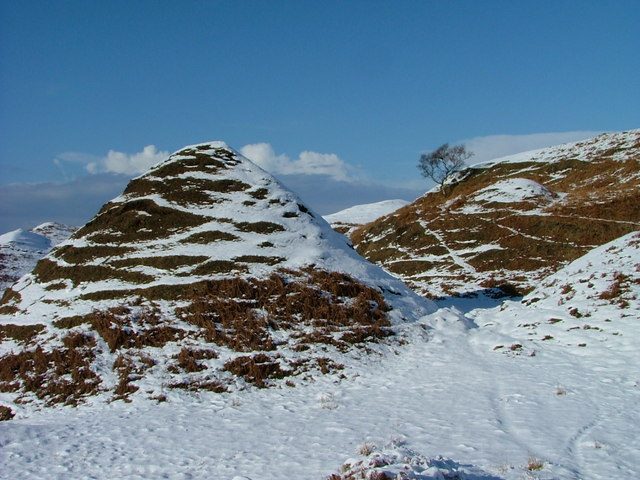
The Fairy Glen is the same process at small scale, on the western flank above Uig. Blocks broke away and rotated, leaving a jumble of grassy cones ten to twenty metres high, flat stepped terraces that look for all the world like cultivation ridges, and hollows that hold water. Sheep have grazed the whole thing smooth over centuries, which is why the shapes read so cleanly. Without grazing it would be a bracken slope and nobody would have heard of it.
Castle Ewen is not a castle
The rock tower at the heart of the glen gets called Castle Ewen, and roughly nine out of ten visitors assume it is a ruin. It is not. It is a natural plug of basalt, weathered into blocky courses that happen to look like collapsed masonry. Local tradition attaches the name to a chief called Ewen; nobody ever built anything up there.
I mention this because the misconception changes how people treat it. Visitors climb what they think is a ruined wall and discover, about two-thirds of the way up, that they are on a steep, loose, exposed lump of rock with a genuine drop on the far side.
The name, and the folklore that is not there
Be a little sceptical of any guide that hands you a detailed fairy legend for this specific glen. The Gaelic name of the settlement is Bail’ nan Cnoc — roughly, the village of the hills — and the “fairy” label is a much more recent, English-language description of a landscape that looks miniature and odd. Skye has genuine, well-documented fairy tradition, notably the Fairy Flag of the MacLeods at Dunvegan. This hillside is not the source of it. The place is remarkable enough as a landslip without borrowing a legend.
Getting there: the turning, the road and the car park
From Portree
Take the A87 north-west out of Portree, follow it round towards Uig, and after about 16 miles you will drop down the hill with Uig Bay opening up ahead. Just before the Uig Hotel, with Captain Fraser’s Folly — a stubby round tower — on the other side of the road, there is a turning signposted for Sheader and Bail nan Cnoc. Take it and climb for a mile and a half. Allow 30 to 35 minutes from Portree, longer in August behind a motorhome.
From Uig pier
Coming off the ferry, head up the hill on the A87 towards Portree for about three miles, pass the Uig Hotel on your left, and turn left at the same Sheader and Bail nan Cnoc sign. Eight to ten minutes, door to car park.
A word on satnav
Postcodes here are unreliable and different guides quote different ones, because a single Uig postcode can cover a lot of scattered croft houses. Do not trust a postcode. Search “Fairy Glen car park” in your mapping app before you lose signal, or simply navigate to Uig and look for the brown-and-white sign. Mobile coverage on the glen road is patchy at best.
One more search tip. Listings and signage use several names for the same hillside — Fairy Glen Uig, Fairy Glen Isle of Skye, Balnaknock and Bail nan Cnoc all mean this one place. Searching the Uig version pins the right corner of the island straight away and saves you being sent south towards Glenbrittle.
The single-track road
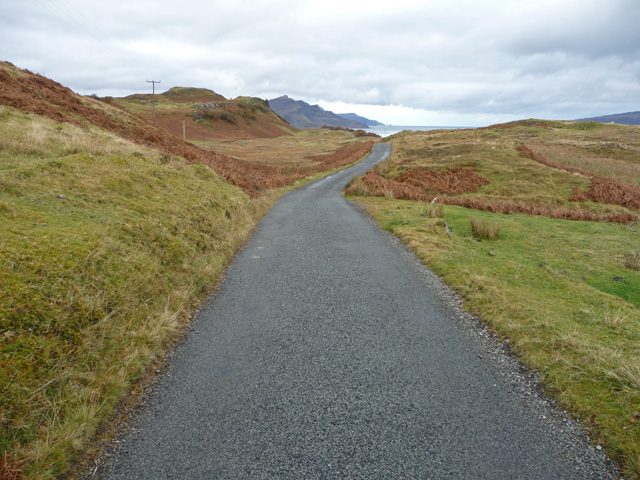
This is the part that catches people out. The glen road is properly single-track, with passing places, blind summits and a gradient. It is also somebody’s route home, their route to the school bus and the route the vet takes.
The rules are simple and worth stating plainly, because a lot of visitors clearly have not driven one before. Passing places are for passing and for letting faster traffic overtake — they are not viewpoints or picnic spots. If the passing place is on your right, stop opposite it rather than crossing into it. Never park in one. Give way to anything larger, and to anything local: they are working, you are not. And keep your speed down, because sheep on Skye have no road sense whatsoever and lambs bolt in the wrong direction.
If you are driving Skye for the first time, the wider etiquette is worth reading up on in our guide to getting around Scotland, and the Skye itinerary builds in realistic driving times rather than the ones your satnav promises.
Fairy Glen parking, and why you are being charged
There is a small pay-and-display car park on the left as you climb, with marked overspill bays along the roadside. At the time of writing the tariff was around £2 for two hours and £3 for up to four, chargeable through the day, with a machine that takes coins and contactless. Budget a fiver in case it has risen and check the sign when you arrive.
Some visitors grumble about paying. They should not. Before the car park existed, cars simply stopped on the verges of a single-track road, tore up the grass, blocked farm access and made the whole thing impassable for anyone who actually lived there. The charge exists because the place was being wrecked by the sheer number of people who wanted to see it for fifteen minutes. Paying £3 is the least demanding form of conservation you will ever be asked to do.
There are no toilets at the glen. Nearest facilities are down in Uig. Please do not improvise — there is almost no cover, and the ground is grazed.
Without a car
It is awkward but not impossible. The Stagecoach 57 between Portree and Uig, and the Citylink coach service, will drop you on the A87 near the Uig Hotel; from there it is roughly a mile and a half of uphill single-track walking to the car park, and the same back. Buses are infrequent, so check the timetable and give yourself a long margin. Several Skye day tours from Portree include the glen as a short stop — the options are compared in our roundup of Isle of Skye tours. If you are planning the whole trip on public transport, our Scotland without a car itinerary is honest about which island stops genuinely work.
The walk: what to actually do when you get there
Calling this a hike oversells it. It is a wander, and the pleasure of it is in poking about rather than covering ground. The whole thing is roughly a kilometre of walking if you loop it properly.
Ten minutes: the lochan and the lower road
From the car park, carry on along the road on foot rather than heading straight up. You pass a small reed-fringed lochan on your left and, a little further, a turning area where the ground drops away into Glen Conon. Stop there. The view back across the glen towards Kilmuir, with waterfalls threading down the far side after rain, is better than anything you will find inside the glen itself, and about nine in ten visitors skip it entirely because it looks like the wrong direction.
Fifteen minutes: up to the foot of Castle Ewen
Retrace your steps and take the worn path that climbs towards the rock tower. It is short, steep and greasy after rain — think five minutes of puffing rather than a climb. Near the bottom you pass mossy stone foundations and a handful of gnarled rowans, which are the oldest human trace in the glen and worth a proper look.
At the top the ground levels out at the foot of Castle Ewen. For most people this is the destination: you are among the cones, the terraces step away below you, and the whole miniature landscape finally makes visual sense.
The scramble to the top, and who should skip it
From that flat area a gravel path climbs the side of Castle Ewen and finishes with a genuine hands-on scramble over the last few metres. I want to be blunt about this, because the photographs make it look like a stroll.
It is steep, the surface is loose gravel over rock, and the summit is a small exposed platform with a serious drop on the far side. There is no fence, no chain, no handrail. Wet basalt is slick. In trainers, on a wet day, with a child, it is a bad idea — and I say that as someone who is generally relaxed about Scottish scrambling. Every season brings reports of people getting up and then finding they cannot get back down, which is the classic scrambling trap.
The view from the top is good rather than transformative. If anyone in your group is unsure, stop at the base. You lose very little. If you want height and a big view without the exposure, the Old Man of Storr walk gives you far more for the effort, on a graded stone path.
The full loop: 45 to 60 minutes
From Castle Ewen, follow the path back out of the glen with the rock on your right, then take the right-hand branch before the lochan. It winds around the water and through the hillocks before dropping to the car park. That is the complete circuit: no navigation required, no map needed, and it delivers you back to the car with your ankles intact.
Stick to the paths. Large parts of the glen have been roped off to let the grass recover from being trampled bare, and those cordons are not decorative. The bare, scarred ground you can still see on the popular hillocks is a preview of what happens when everybody walks wherever they like.
The stone spirals: please do not build them
This is the part most guides get wrong, so I will be direct.
They are not ancient, and they are not fairy anything
There is a large spiral pattern in the turf below Castle Ewen, usually outlined with loose stones, plus assorted circles and stacked cairns scattered around the glen. Visitors made them. Recently. They have no folkloric standing, no ritual meaning and no age — the enthusiasm for building them tracks almost exactly with the rise of Skye on Instagram. Guides that describe a “labyrinth” where you can make a wish are inventing a tradition on the spot and then selling it back to you.
What they actually do
Prising stones out of the ground for a stack strips the vegetation holding thin hill soil in place, and on a landslip site with heavy footfall that means accelerating erosion of the exact features people come to see. It also disturbs the cover that small creatures use, and it rearranges a working hill farm for the sake of a photograph.
Skye residents have organised clean-ups to dismantle them — volunteers from Portree, Kensaleyre, Uig, Kilmuir and Staffin have turned out to remove stones and litter from the glen, in one reported case pulling apart more than a hundred stacks in a single session. Conservation bodies and land managers across the Highlands have made the same request repeatedly. So the honest position is this: locals spend their weekends taking these apart, and every guide that photographs them approvingly is generating more work for the people who live there.
If you find a spiral already built, leave it alone. Do not add to it, do not source fresh stones for it, and do not take a stone away as a souvenir either. Photograph the landscape instead.
The rest of the code
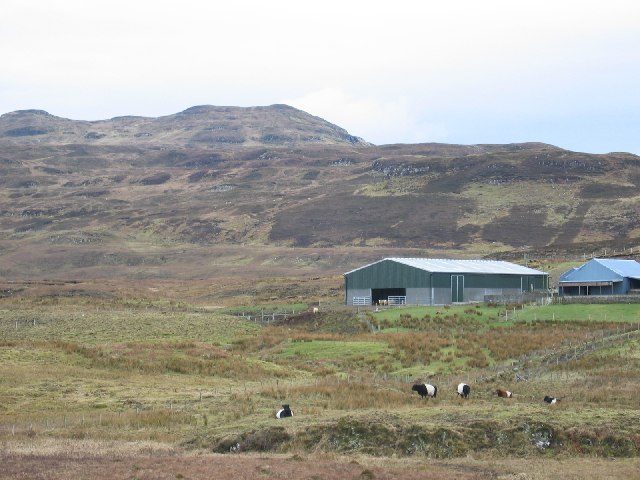
This is croft land, worked by people, and access in Scotland comes with responsibilities as well as rights. Keep dogs on leads — livestock roam freely, and lambing runs from roughly March to May. Shut gates behind you. Take litter home, including fruit peel. Do not fly a drone over grazing animals or over the heads of other visitors. And do not park across a field gate, however briefly.
When to go, and the honest truth about the light
Time of day matters more than anything else
Here is what nobody says out loud: in flat, overhead midday light, the Fairy Glen photographs as a lumpy green field. The whole appeal is relief — the cones only read as cones when low sun rakes across them and throws shadows down their flanks. At 1pm in June you will stand there wondering what the fuss was about.
Go in the first two hours after sunrise or the last two before sunset. In midsummer that means before about 8am or after about 8pm, which sounds absurd until you remember Skye’s daylight runs to nearly 11pm in June. In October the good light arrives at civilised hours, roughly 8–10am and 4–6pm, which is one of several reasons I keep recommending October in Scotland to photographers.
Season by season
Spring is my pick. April and May bring long light, the grass greens up, and the road is quiet — and crucially the midges have not arrived in force. Summer gives you endless daylight but also the fullest car park and the peak of the Scottish midge season; a still, damp evening at the lochan in July is a genuinely unpleasant experience, so carry repellent and a head net if you plan to linger.
Autumn is the sweet spot for light and colour, with bracken turning rust across the hillocks. Winter is bleak, beautiful and often the best of all — low sun all day, frost picking out the terraces, snow making the cones look like something out of a storybook — but the road can be icy, daylight is short, and you need to be comfortable driving single-track in poor conditions. Our month-by-month weather guide and the broader notes on the best time to visit Scotland will help you pick.
Crowds
The pinch is roughly 11am to 5pm from June to August, when Skye’s coach tours and self-drivers arrive in a block. Before 9am and after 6pm you may well have the glen to yourself, and the light is better anyway. It is one of the rare cases where the responsible choice and the selfish choice are identical.
Pairing it with the rest of Trotternish
The Fairy Glen is a 45-minute stop, not a day. Build it into the Trotternish loop, a roughly 50-mile circuit from Portree that takes in the best of northern Skye.
Uig itself
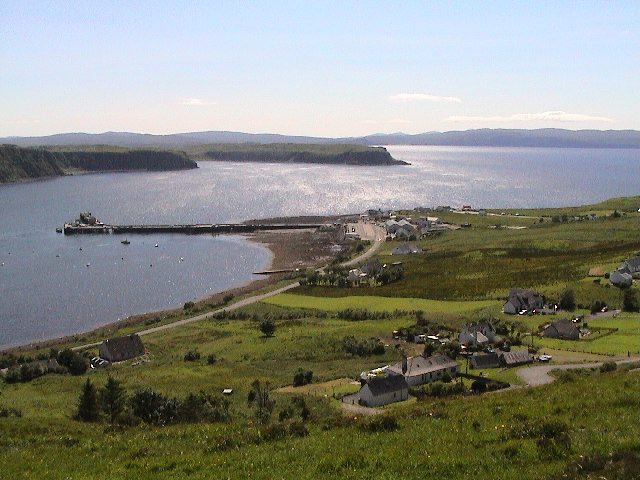
Do not just drive through. Uig Bay is a broad half-moon of shoreline with a pier at one end, and the village has a brewery and a couple of places to eat. It is also the departure point for the Outer Hebrides, which gives the harbour a working, purposeful feel that most of Skye’s tourist stops have lost.
The Quiraing
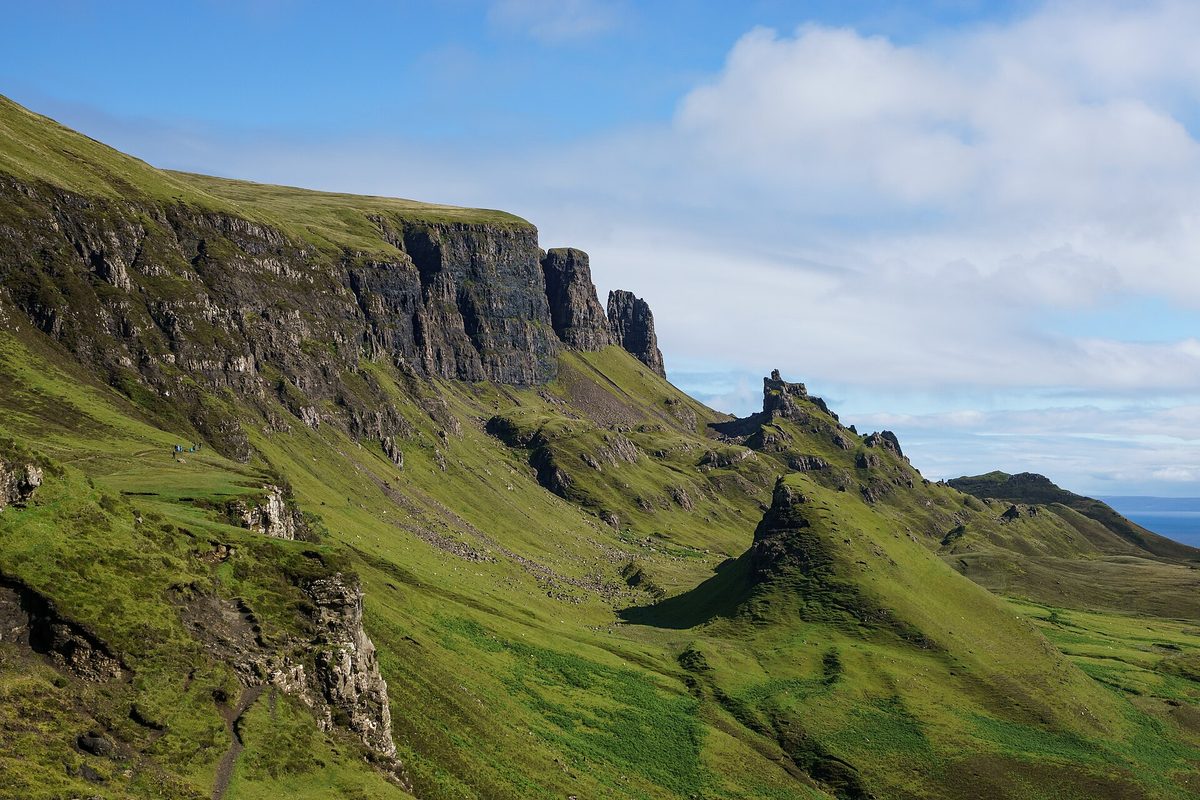
Fifteen miles north, over the Staffin road, is the full-scale version of what you have just been looking at: the same landslip geology, but on a heroic scale, with pinnacles and hidden plateaus. It is a proper walk with real exposure in places, and I would set aside two to three hours. The route, the parking situation and the safety caveats are all in our Quiraing walk guide. Doing the Fairy Glen first and the Quiraing second makes the geology click.
Kilt Rock, Lealt and the Storr
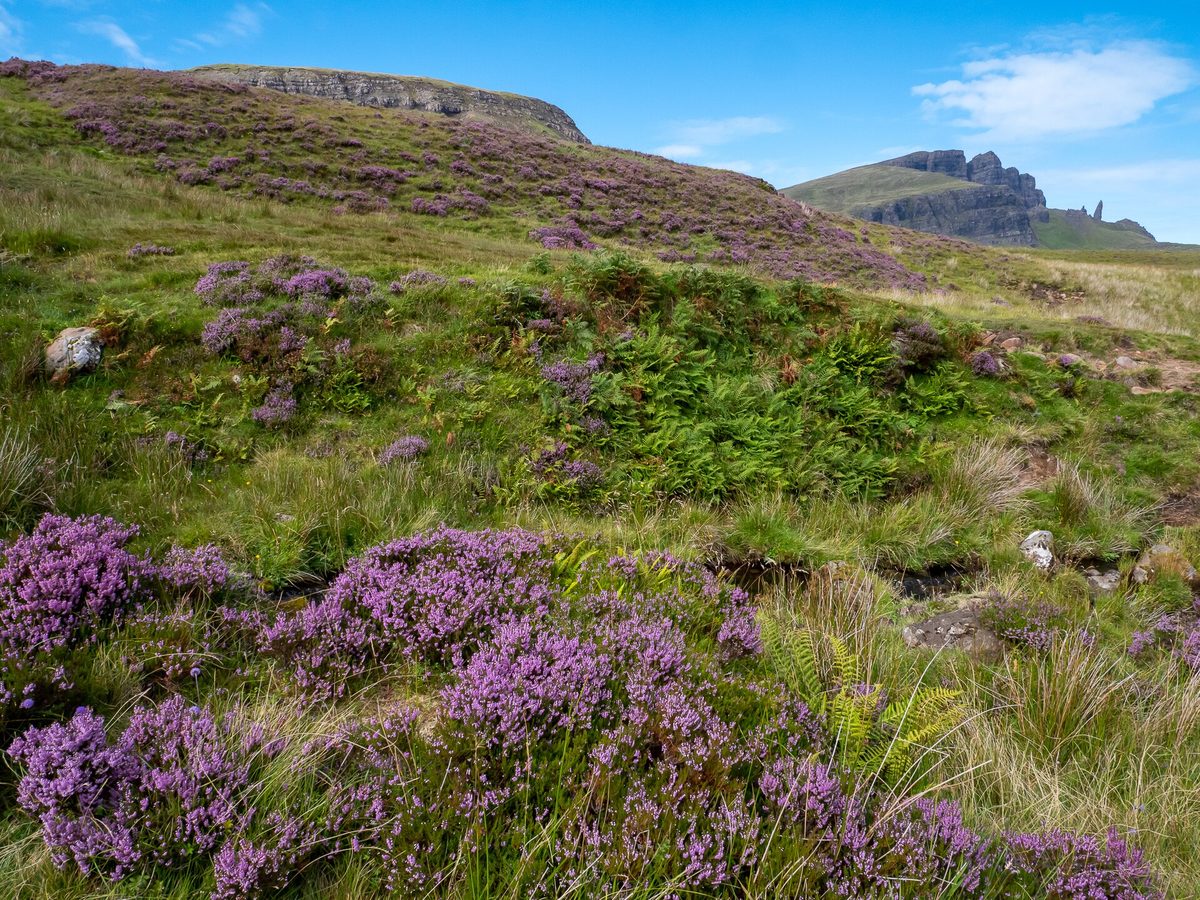
Coming back down the east coast you get Kilt Rock and Mealt Falls — a two-minute stop from a car park, honestly, and none the worse for it — then Lealt Gorge, then the Old Man of Storr. The Storr car park fills by mid-morning in summer and the path is now a well-built stone staircase; allow 90 minutes to two hours return.
A loop day that works
If I had one day in northern Skye, I would leave Portree at 7.30am, do the Storr while the car park is still half empty, take Kilt Rock as a quick stop, walk the Quiraing late morning, eat in Uig, and finish at the Fairy Glen in the late afternoon as the sun swings west. That sequence puts each place in its best light, which is not a coincidence — it is how the peninsula is oriented.
West Skye is a separate day. If you have the time, the run out to Neist Point lighthouse for sunset is the other great low-light spot on the island, and the two make a natural pair for anyone who cares about photographs.
Planning practicalities
How long to allow
Thirty minutes gets you the loop at a brisk pace. Forty-five is comfortable. An hour and a half lets you climb Castle Ewen, walk down to the Glen Conon viewpoint and sit for a while. I would not build a longer visit than that — there simply is not more to see, and pretending otherwise is how guides pad their word counts.
Where to base yourself
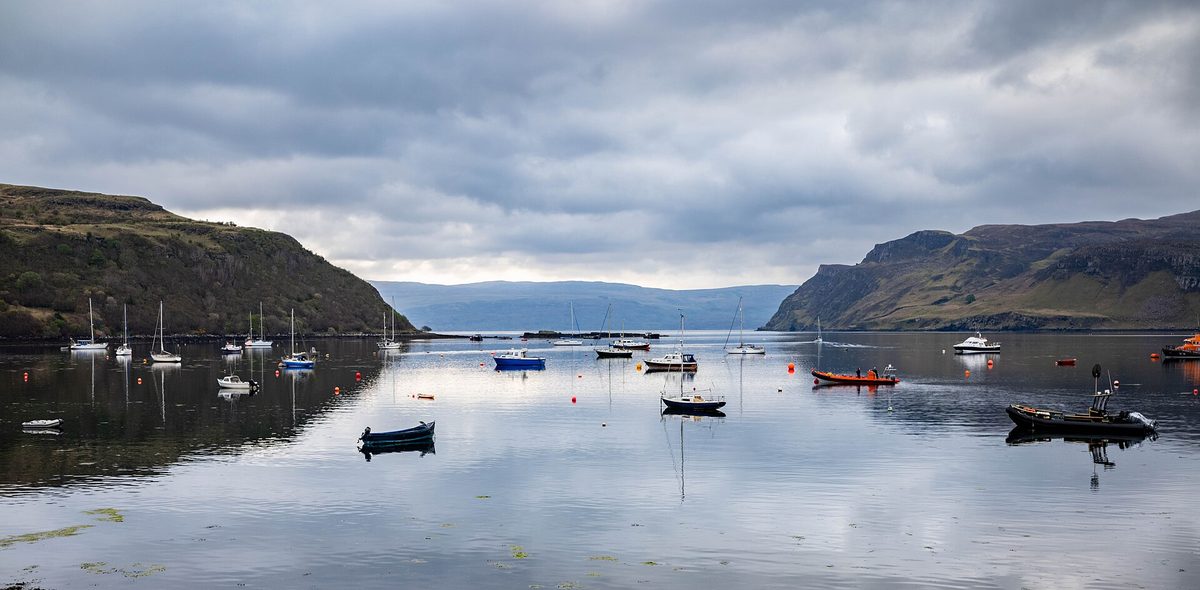
Portree is the obvious base, 30 minutes away, with the widest choice of beds and food. Uig itself is closer and quieter, with a hotel, a hostel and self-catering scattered around the bay, and it is the sensible choice if you are catching an early ferry. Staffin and Kilmuir put you near the Quiraing. Book far ahead: Skye accommodation for June to August routinely sells out by February, and prices are unapologetic. Our guide to where to stay on the Isle of Skye breaks the island down by area.
If you are catching the ferry to the Outer Hebrides
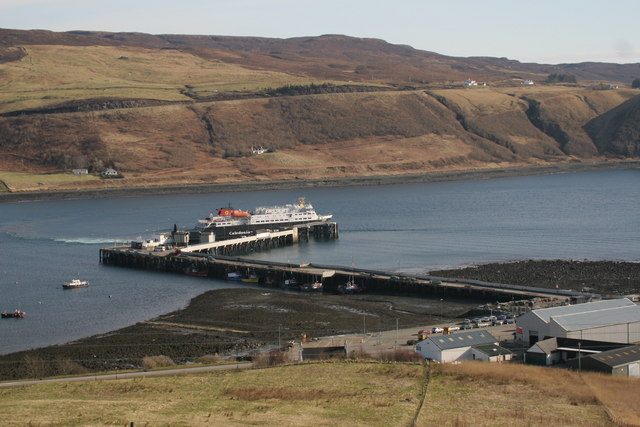
This is the Fairy Glen’s most practical use, and almost nobody writes about it. CalMac sails from Uig to Tarbert on Harris and to Lochmaddy on North Uist, and vehicle check-in closes well before departure — allow at least 30 minutes, more in summer. If you have an hour and a half of dead time before a sailing, the glen is eight minutes up the hill and fits perfectly.
Two warnings. Do not cut it fine: the single-track road can be blocked by an oncoming motorhome for several minutes at a time, and there is no way to hurry it. And check the sailing status the same morning, because Little Minch crossings are cancelled by weather fairly often, particularly between October and March. Timetables and live disruption notices are on calmac.co.uk. If the boat is your gateway to the islands, our overview of Scotland’s islands covers what lies on the other side, and how to get to Skye deals with the approach from the mainland.
What to wear and carry
Boots or trainers with real grip — the paths turn to slick mud within hours of rain and stay that way for days. Waterproof jacket regardless of the forecast; Skye weather changes on a twenty-minute cycle. Layers, because the glen sits at a few hundred feet and catches the wind off the Minch. Midge repellent from late May to September. Water, because there is nothing on site. And a bag for your rubbish.
What underwhelms, and the mistakes I see most
Now the honest bit, because you deserve to arrive with the right expectations.
It is small. Genuinely small. If you have come expecting an afternoon’s worth of landscape, you will be deflated within ten minutes. Think of it as a curiosity you visit between larger places, and it delivers; think of it as a destination in its own right and it cannot carry the weight.
The photographs you have seen were taken at dawn, in autumn, probably with a drone. What you will see at midday in July, from ground level, with forty other people on the hillocks, is a different thing entirely. That is not a criticism of the place. It is a criticism of how it is sold.
People treat the scramble as a photo opportunity. The most common mistake here is not getting lost or getting cold, it is going up Castle Ewen in unsuitable footwear because it looked easy from below. The second most common is going up carrying a small child.
People try to do it as a detour from the Fairy Pools. They are not near each other. If your plan involves both in an afternoon, redraw the plan.
The single-track road claims its share of wing mirrors. Slow down, use the passing places properly, and reverse when it is your turn to reverse.
And the stones. The most common mistake of all is arriving, seeing everyone else building little cairns, and assuming it must be fine. It is not fine. It is a decade-old habit that locals actively dismantle. If you take one thing from this guide beyond the Fairy Pools distinction, make it that. A broader set of ground rules for rural Scotland is collected in our Scotland travel tips.
Frequently asked questions
Is the Fairy Glen the same as the Fairy Pools?
No, and this is the single most common mix-up on Skye. The Fairy Glen is a landslip of grassy cones above Uig in the north; the Fairy Pools are waterfalls and swimming pools at Glenbrittle in the south-west. They are around 40 miles and an hour and a quarter of driving apart, and they make completely different days out.
How much does it cost to visit the Fairy Glen?
Entry is free. You pay only to park: roughly £2 for two hours and £3 for up to four at the time of writing, payable by card or coins at the machine. Prices change, so check the sign on arrival. The charge funds the car park that keeps cars off the verges of a single-track road.
How long does the Fairy Glen walk take?
Thirty minutes for a quick circuit, 45 to 60 for a proper wander, and 90 if you climb Castle Ewen and walk out to the Glen Conon viewpoint. The full loop is about a kilometre on grass and mud with one short steep section. It is a stroll, not a hike, and needs no navigation.
Can you climb Castle Ewen?
Yes, but treat it seriously. A steep gravel path leads to a hands-on scramble over the final few metres onto a small, unfenced platform with a big drop beyond. Wet or icy rock makes it genuinely hazardous. It is not suitable for young children or for anyone in smooth-soled shoes, and the view from the base is nearly as good.
Is the Fairy Glen suitable for children and pushchairs?
Children enjoy the lower glen — the hillocks are irresistible — but pushchairs and wheelchairs will not manage the paths, which are grass, mud and uneven ground with a steep climb. Keep children well away from the Castle Ewen scramble. For softer family days on Skye, see our ideas for Scotland with kids.
Should I build a stone circle at the Fairy Glen?
No. The spirals and cairns are recent visitor creations with no folkloric basis, and local volunteers regularly dismantle them because pulling stones from the ground damages thin soil and worsens erosion on an already fragile landslip. Leave existing ones alone rather than adding to them, and do not take stones away either.
When is the best time of day to visit the Fairy Glen?
Early morning or the last couple of hours of daylight. The cones and terraces only show their shape in low, raking sunlight; at midday the place flattens out visually. Early and late also dodge the 11am to 5pm summer crush, so you get better light and an emptier glen at the same time.
Do I need a car to visit the Fairy Glen?
It helps enormously. Buses between Portree and Uig stop on the A87 roughly a mile and a half below the glen, leaving you an uphill road walk each way on a service that runs infrequently. Organised Skye tours from Portree often include a short stop, which is the simplest car-free option.
Final thoughts
The Fairy Glen is one of those places that rewards low expectations and good timing in equal measure. Arrive at noon in August expecting a fairy kingdom and you will leave puzzled. Arrive an hour before sunset in late April, walk the loop slowly, sit at the foot of Castle Ewen and watch the shadows stretch down the cones, and you will understand exactly why people keep coming back to this corner of the Isle of Skye.
Just leave the stones where they are. The rock has managed for sixty million years without our arrangements, and the people who live below it would quite like a weekend off.
About the author: This guide was written and is maintained by the ScotlandTourism.org editorial team — travel writers who’ve spent years exploring Scotland’s cities, Highlands and islands, from bagging Munros to chasing the perfect dram. We update our guides regularly to keep prices, opening details and advice current.
Last updated: August 2026. Prices and opening times change — always check the official site before you travel.
Photo credits
All images are used under their respective Creative Commons or public-domain licenses:
- The Fairy Glen on Skye seen from across Glen Conon, a mass of green hummocks below the Trotternish escarpment — Dave Fergusson, CC BY-SA 2.0, via Wikimedia Commons
- Cone-shaped grassy hillocks in the Fairy Glen above Uig, Isle of Skye, under winter snow — Dave Fergusson, CC BY-SA 2.0, via Wikimedia Commons
- Glen Brittle and the Cuillin, where the Fairy Pools are, forty miles from the Fairy Glen on Skye — Lukas von Daeniken, CC BY-SA 2.0, via Wikimedia Commons
- The Trotternish escarpment on Skye, the landslip geology that also produced the Fairy Glen — John Allan, CC BY-SA 2.0, via Wikimedia Commons
- Single-track road with passing places on the Isle of Skye, similar to the road up to the Fairy Glen — John Allan, CC BY-SA 2.0, via Wikimedia Commons
- Cattle grazing on working croft land in Trotternish, Isle of Skye — John Allan, CC BY-SA 2.0, via Wikimedia Commons
- Uig bay and pier on the Trotternish peninsula, the village below the Fairy Glen on Skye — Andrew McLean, CC BY-SA 2.0, via Wikimedia Commons
- The Quiraing on the Trotternish ridge, the larger landslip north of the Fairy Glen on Skye — Colin, CC BY-SA 4.0, via Wikimedia Commons
- The Old Man of Storr on the Trotternish peninsula, an easy pairing with the Fairy Glen — Thomas Andy Branson, CC BY-SA 4.0, via Wikimedia Commons
- A CalMac ferry at Uig pier, the sailing point for Harris and North Uist — Dean Howard, CC BY-SA 2.0, via Wikimedia Commons
- Portree harbour on the Isle of Skye, the usual base for a visit to the Fairy Glen — rboed*, CC BY 2.0, via Wikimedia Commons