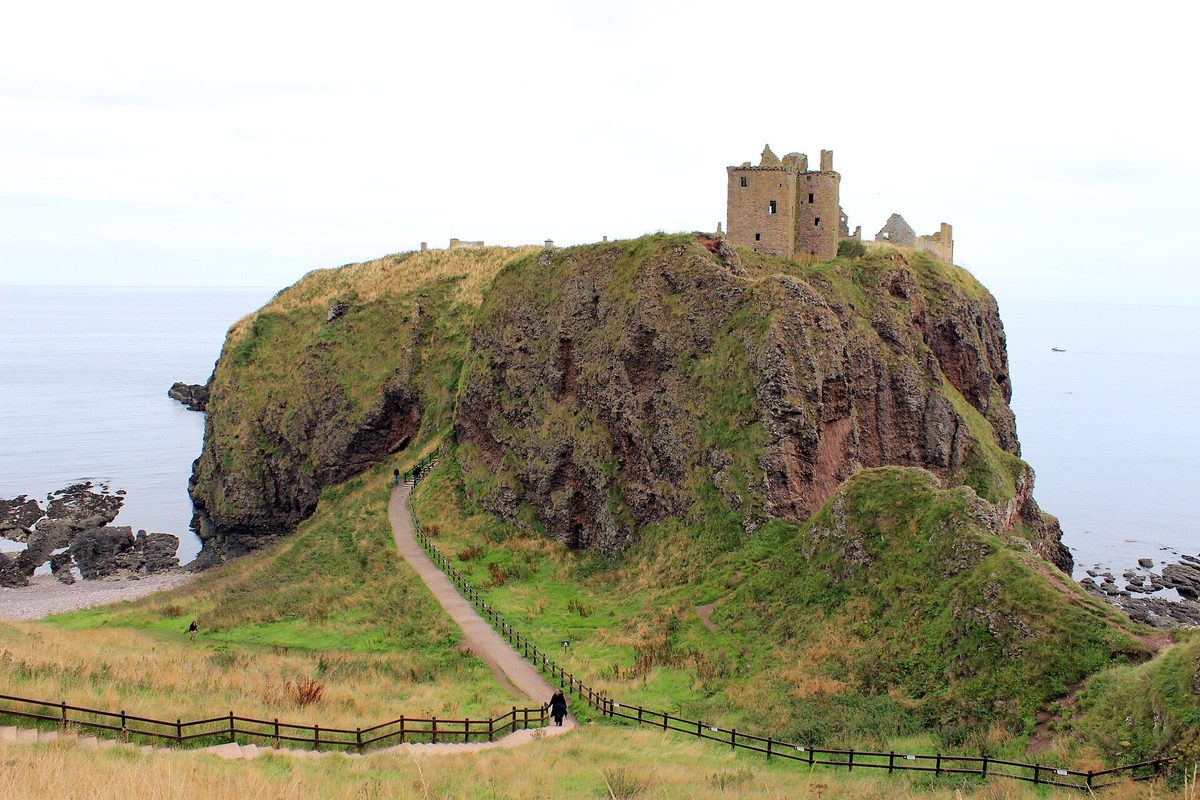
From the car park, Dunnottar Castle looks like an easy stroll, and the first stretch to the clifftop is exactly that. Then the path reaches the edge, and a long flight of concrete steps drops away towards the rock. That is the part of the visit to plan for.
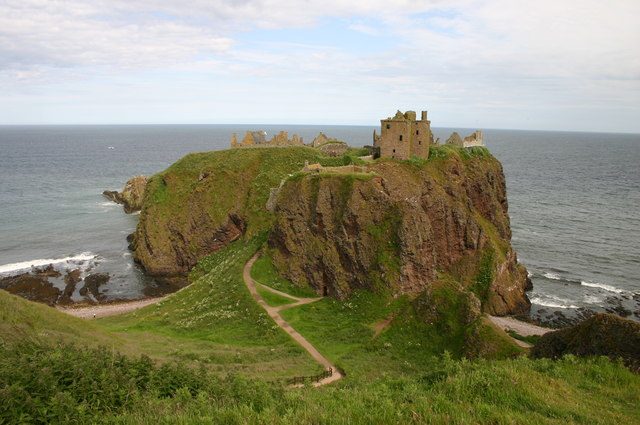
That is the honest place to start. The photographs you have already seen are accurate — a hollow sandstone fortress on a green-topped stack with the North Sea on three sides. What they leave out is that the castle sits in a gap in the coastline, and reaching it means walking down into that gap and back out again. Roughly a quarter of an hour each way, a few hundred steps, no shortcut. Once you know that, the rest of the visit is straightforward and the place is worth every bit of the effort.
The short version
Dunnottar Castle is a privately owned clifftop ruin 1.6 miles south of Stonehaven in Aberdeenshire. Adult entry is £13.50. It opens on a seasonal timetable, with set closure days over Christmas and New Year, and it can shut at short notice in bad weather. Getting in means about 300 metres of level path and then 283 steps each way, so there is no wheelchair access, and the castle cannot store buggies.
Dunnottar Castle at a glance
| Detail | What to expect |
|---|---|
| Where it is | 1.6 miles south of Stonehaven, just off the A92. Postcode AB39 2TL; what3words rubble.desiring.paying |
| Who runs it | Dunecht Estates, privately. Not Historic Environment Scotland, not the National Trust for Scotland |
| Tickets | Around £13.50 adult, £12 concession, £6.25 child 5–15, under-5s free. Card only on site. Prices quoted to 31 March 2027 — check before you travel |
| Opening | Daily 09:00–18:00 from 1 April to 30 September; from 10:00 with earlier closing October to March. Last entry one hour before closing |
| Getting in | About 300m of level path, then roughly 180 steps down and around 100 more up, and the same again in reverse on the way out |
| Parking | Free castle car park, small, fills early on summer mornings. Public harbour car park in Stonehaven if you walk out instead |
| Time needed | Allow for the walk in and out as well as the ruin itself, and more if you want the north viewpoint properly |
| Best light | Late afternoon into golden hour, photographed from the clifftop path north of the castle |
The part nobody warns you about: the walk in and out
Every guide to Dunnottar mentions that it is on a rock. Very few explain what that means for your legs. Here is the route in order, with the numbers the castle’s own access guide publishes.
Car park to clifftop: the easy bit
From the car park you follow roughly 300 metres of earth and gravel path across the fields towards the sea. It is broadly level, wide enough for two, and takes five minutes at a stroll. So if someone in the group has mobility problems, the visit need not be written off. You can get all the way to the clifftop, stand at the fence and look straight across at the castle, and that view alone is the one that ends up on people’s walls.
Between April and mid-September the coach park attendants can sometimes let a vehicle drive down to the turning circle at the end of that path, the closest point to the clifftop viewpoint. Worth asking on arrival rather than assuming.
Clifftop to castle: about 280 steps
Then the ground falls away. From the clifftop you descend around 180 concrete steps — even, well built, but relentless. At the bottom there is about 40 metres of earth path across the neck of the rock, and then you go up again: roughly 38 uneven stone steps to the entrance door, and a further 17 uneven ones inside to reach the ticket kiosk. Some of those are inlaid with pebbles that turn glassy when wet. From the kiosk it is another 48 steps of ragged construction before you reach the open interior.
Add it up and you are looking at roughly 280 steps in each direction, plus the path. Fifteen minutes each way is a fair average for a reasonably fit adult who stops once or twice to look. Give it twenty-five if you are taking photographs, and rather more coming back up.
Who genuinely struggles
Wheelchair access is not possible. Buggies are equally hopeless — there is nowhere to leave one, because the castle cannot store prams or luggage, so you are carrying the child or you are not going down. Personal assistants accompanying a disabled visitor get in free.
Dodgy knees are the other big one. The descent is harder on knees than the climb is on lungs, and the return leg is a long steady haul at the end of a visit when you are already tired. If that describes you, do the clifftop view and skip the interior.
What to put on your feet
Trainers with a decent tread are the minimum, because the pebbled steps turn slippery in the wet. Walking boots are better. Take a waterproof regardless of what the sky looked like in Aberdeen.
Dunnottar Castle parking, and why walking might beat driving
The castle car park
There is a free car park at the castle for visitors, with two designated Blue Badge bays. It is also small, and that is the crux of it. On a fine July or August morning it fills by mid-morning and the overflow ends up along the verges of the approach road, which is legal in places, unwise in others and reliably bad-tempered. The castle asks people to share cars where they can, which tells you everything about the pressure the site is under.
My rule: if you must drive in high summer, arrive before 10am or after 4pm. Both windows are better for light anyway. There are no electric vehicle chargers at the castle; the nearest are in the Town Square car park in Stonehaven.
Walking out from Stonehaven along the coast
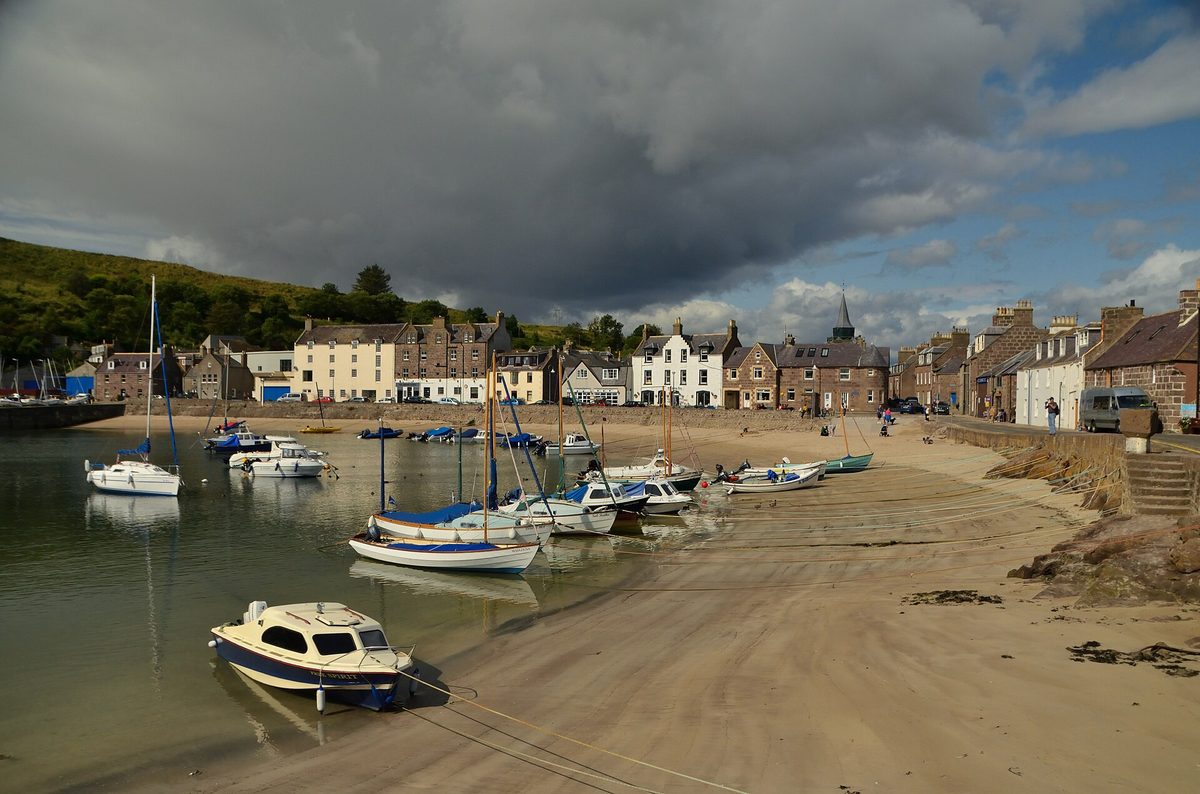
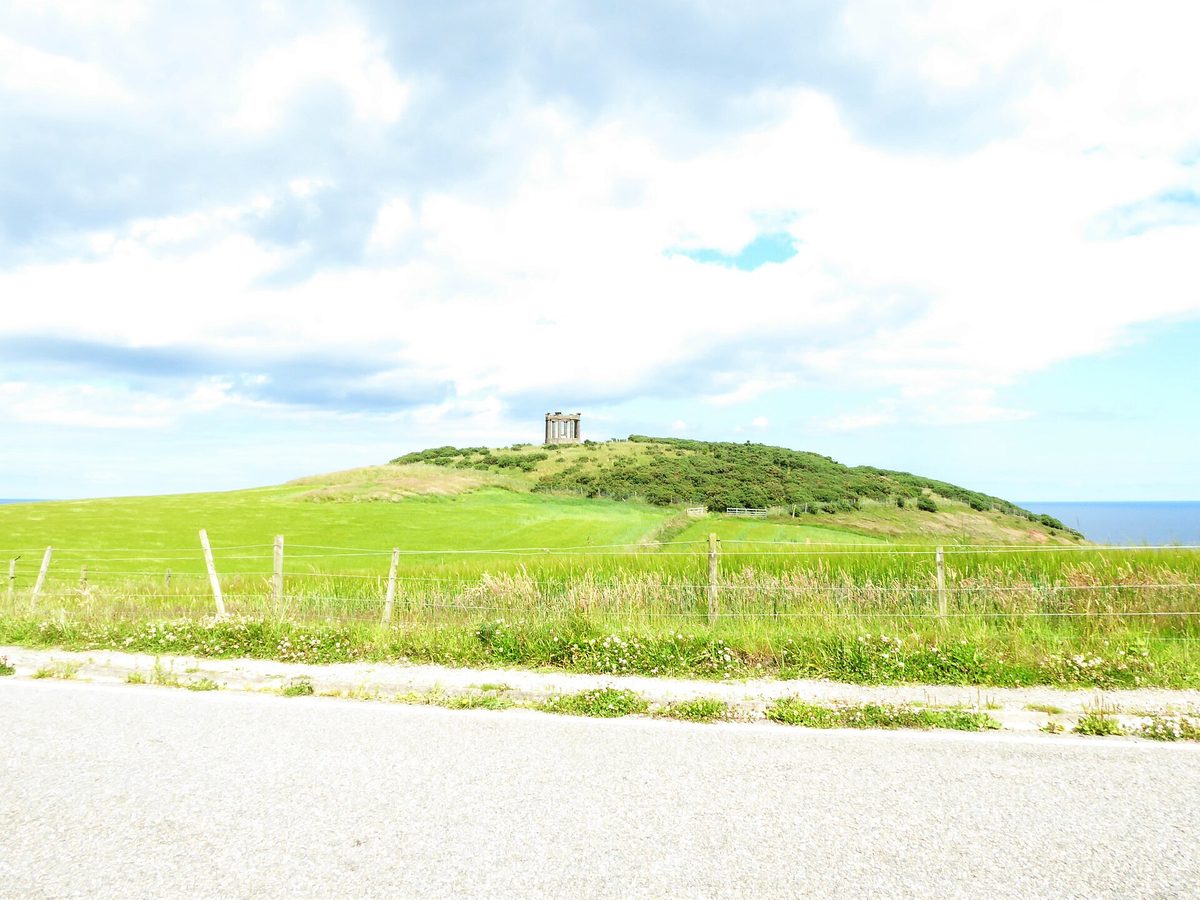
With a spare morning and functioning calves, this is the better way in. Park at Stonehaven harbour behind the Tolbooth, walk past the harbour front, and pick up the signed path that climbs steeply out of the old town by Wallace Wynd onto Bervie Brae. From there a clifftop path runs south past the war memorial on Black Hill, round the back of Strathlethan Bay, and across the headlands to Dunnottar.
The full circuit is a coastal walk of a few kilometres. In practice, an hour each way is the sensible planning figure if you stop for the views, and you will stop. The path passes cliffs, stacks and arches full of seabirds, and there are dolphins and seals off this coast often enough to be worth watching for.
Two things to flag. The first climb out of Stonehaven is steep and comes before you have warmed up. And the cliff edges are dangerous in places, with no fence between path and drop, so this is not a route to let small children run ahead on. A land train sometimes runs between town and castle in summer, a useful get-out for the return leg — check locally whether it is operating.
How to get to Dunnottar without a car
Easier than most Scottish castles, which is a rare pleasure. Stonehaven has its own station on the Aberdeen to Dundee line, so you can be at the harbour within twenty minutes of leaving Aberdeen and walk from there. Stagecoach’s X7 and 107 buses from Aberdeen stop on the A92 a short walk from the castle car park if you would rather not do the coastal path. Local taxi firms in Stonehaven include wheelchair-accessible vehicles.
Aberdeen International Airport is about 20 miles away, roughly 25 minutes by car, or you can take a train from Dyce straight through to Stonehaven. If you are building a whole trip around trains and buses, our guide to exploring Scotland without a car covers the same approach across the country, and there is more general advice in how to get around Scotland. The east coast line is one of the better rides in the country in its own right.
Dunnottar Castle tickets: prices, booking and what you are paying for
What it costs
The published prices to 31 March 2027 are £13.50 for an adult, £12 for a concession — over-65s and students with photo ID — and £6.25 for a child aged five to fifteen. Under-fives are free. A family ticket for two adults and two children is £36, and one adult with two children is £24. The printed guidebook at the kiosk is around £5.
If you live within striking distance, the annual passes are quietly good value: about £33 for an adult, £17.50 for a child and £66 for a family, sold at the kiosk rather than online. Two visits and it has paid for itself. All of these are subject to change, so check the official site the week you go.
One detail that catches people out: the castle takes card payments only. There is no cash desk.
Do you need to book ahead?
Usually not. You can buy at the kiosk on the day. Booking online in advance saves you queuing at the top of the steps in a wind, which on some days is reason enough.
It is not a Historic Environment Scotland site
Dunnottar is privately owned and operated by Dunecht Estates, the Cowdray family having bought it in 1919. An Historic Scotland Explorer Pass will not get you in. Neither will National Trust for Scotland membership. If you have built an itinerary around a multi-site pass, budget for Dunnottar separately.
Historic Houses members do get free entry, which is the one card that works here. It is a different proposition from a state-run site like Edinburgh Castle and its ticketing system, or from the restored interiors at Stirling — and the difference shows in what you get for your money.
Photographing Dunnottar from outside the walls
You do not need a ticket to see Dunnottar Castle well. The clifftop path from the car park looks straight across at it before you reach the kiosk, and that view costs nothing.
The north clifftop viewpoint
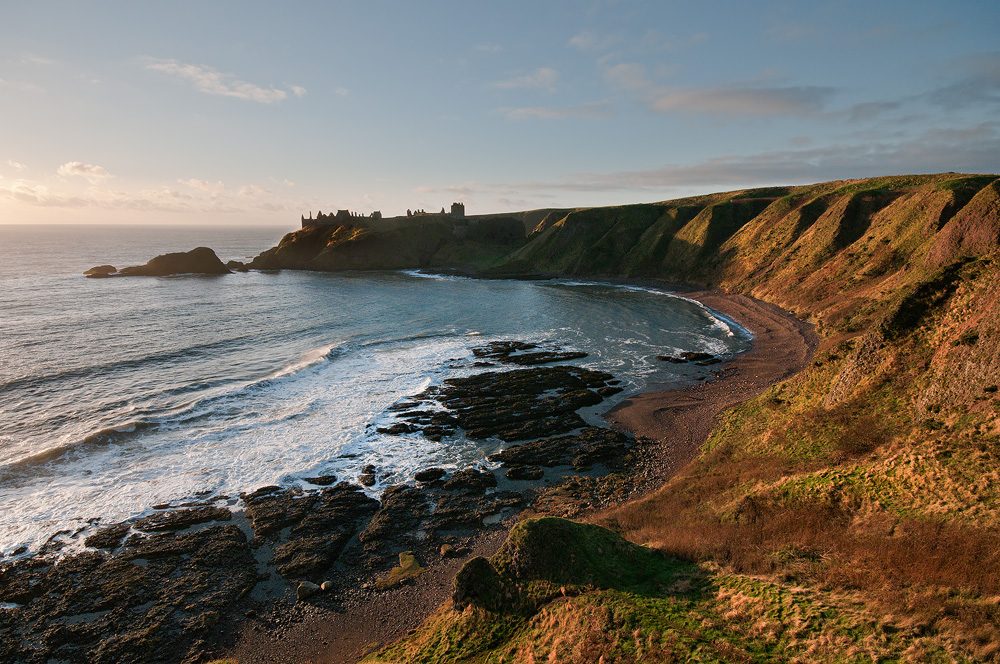
Walk out along the path from the car park and, instead of turning down the steps, carry on north along the clifftop. Within a few minutes you are looking back at the castle across the little bay, with the full profile of the rock and the whole sprawl of buildings along the top. That is the image. It is the one on the postcards, the one on the tourist board pages, and you can stand there for as long as you like without paying a penny.
Several worn paths lead to different vantage points along that stretch, and the ground gets close to unfenced cliff edges, so keep children and dogs firmly in hand. The best of them is around the top of the main steps and a little further north again, where the castle sits side-on with sea behind it.
How the light moves through the day
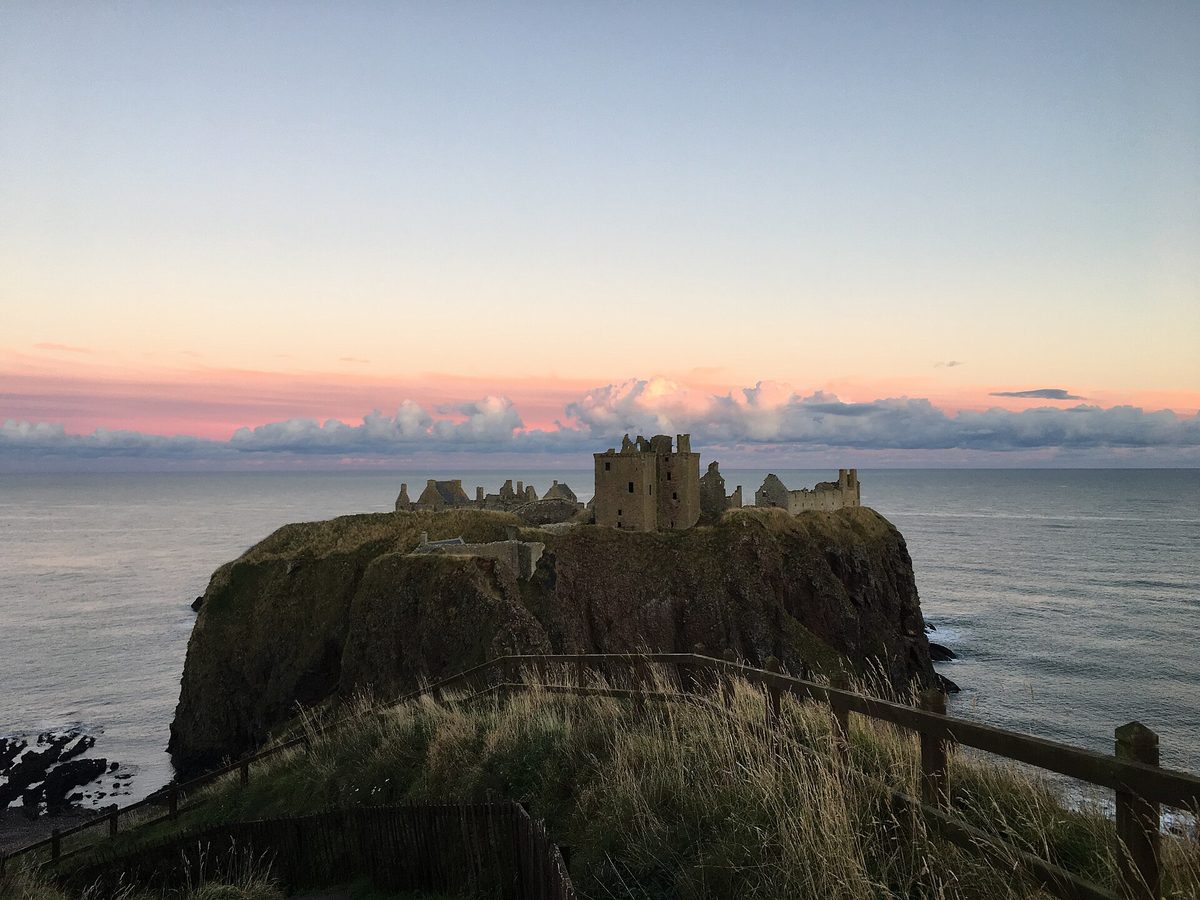
Dunnottar faces east into the North Sea, and that governs everything. In the morning the sun rises out of the water more or less behind the castle when you are standing on the northern clifftop, which means a silhouette. That can be a fine photograph — a black fortress against a pink sky is hard to ruin — but it is not a photograph of the building, and you will get no detail in the stone.
By early afternoon the sun has swung south and the castle is lit flatly. Then, from late afternoon onwards, the light comes over your shoulder from the west and lands squarely on the north and west faces of the ruin. The sandstone goes gold, the grass goes acid green, and the sea behind turns steel. In midsummer that means being on the clifftop at eight or nine in the evening, long after the castle has shut, which is fine because you do not need to be inside. In late autumn it can be as early as three.
If your trip is built around photography, our notes on Scotland’s weather month by month are worth a look, and October in Scotland in particular gives you low light at civilised hours.
Other angles, and drones
From the coast path continuing south towards Crawton you get the castle framed against the northern cliffs, less familiar and often emptier. From the water it is different again — local operators run paddleboarding sessions between Stonehaven harbour and the castle, and seeing the rock rise sheer out of the sea corrects how tame it looks from above.
Casual drone flying is not permitted. Any professional filming or photography needs written consent applied for at least a month ahead, and drone work on top of that requires CAA operational authorisation, a site-specific risk assessment, flight paths, spotter positions and ten million pounds of public liability insurance. That is a permissions regime for film crews, not a formality for hobbyists. Leave it in the car.
What is actually inside the ruin
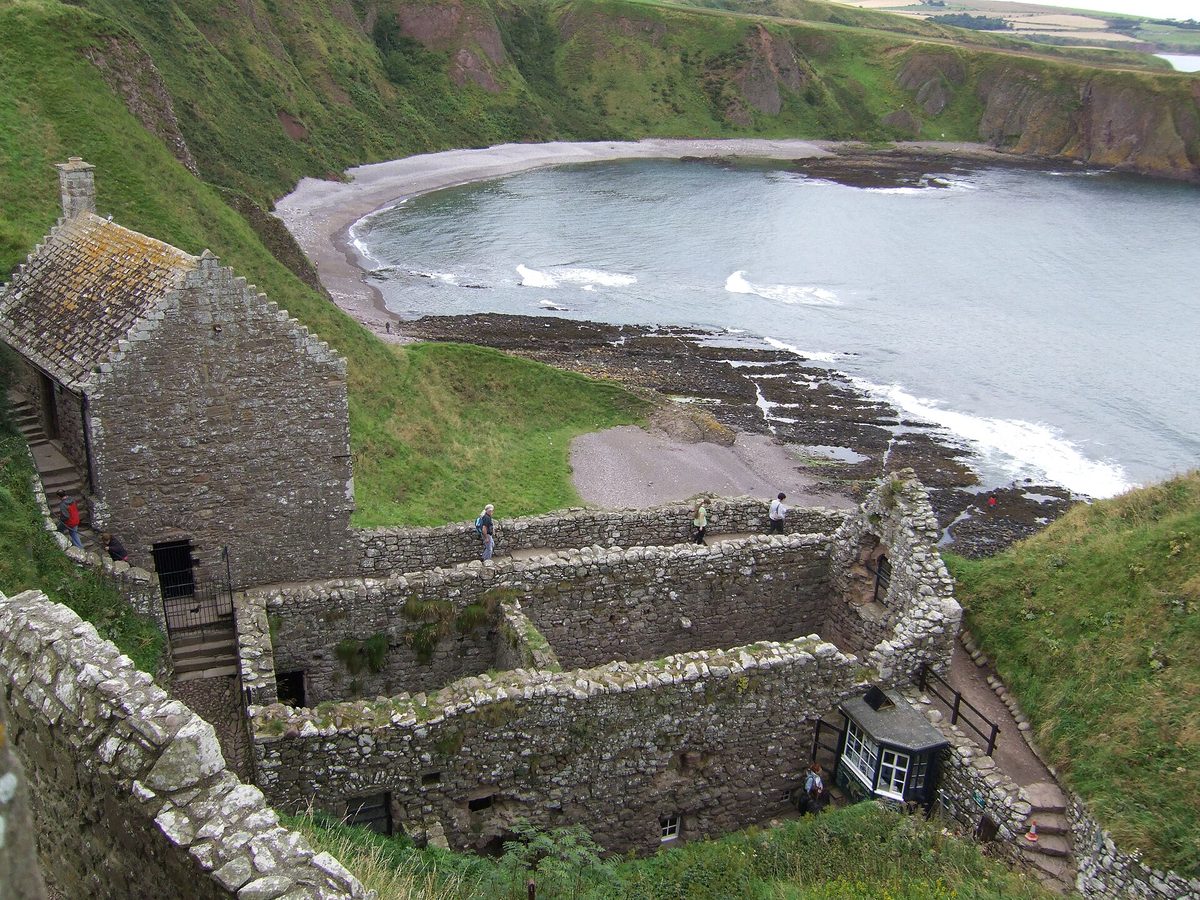
Now the candid part. Dunnottar’s drama is almost entirely external. The interior is a large, windswept, open-air site of about eleven separate buildings dating from the 13th to the 17th centuries, and the great majority are roofless shells with grass floors. If you are expecting furnished rooms and costumed guides, you will be disappointed. There is no café on the rock either; the only refreshments come from the catering van beside the car park.
What you get instead is space, wind and position. A £5 guidebook fills in the history as you go. Toilets are inside the grounds and reserved for paying visitors, which is worth knowing before you commit to the walk.
The keep and the chapel
The tower at the highest point is the oldest substantial building, put up by Sir William Keith around 1392 and the shape you recognise from every photograph. You can walk into its vaulted lower chambers. Nearby, low walls mark the chapel that Bishop William Wishart of St Andrews consecrated in 1276 — parts of that fabric survive, making it the earliest thing still standing here.
The palace ranges and the drawing room
Along the seaward edge, the 16th and 17th-century palace buildings run around a quadrangle. This is the most rewarding corner of the site, and the restored drawing room is the one interior that suggests how people actually lived up here rather than merely defended the place.
The Whigs’ Vault
A low, dark cellar where over 167 Covenanters were held in 1685 for refusing to accept religious reforms. Conditions were appalling and several died. It is a small, unremarkable-looking room and it is easily the most affecting thing on the rock. Read the sign before you go in, not after.
What was filmed here
Zeffirelli’s 1990 Hamlet with Mel Gibson was filmed at Dunnottar. The castle also lists itself as an inspiration for Disney’s Brave. If you are chasing screen locations more widely, our guide to Outlander filming locations covers the better-signposted trail.
How long you need inside
Forty-five minutes to an hour is plenty for most people, or an hour and a half if you are photographing seriously. Add the walk in and out on top of that, and more time again if you are adding the northern viewpoint.
The history that makes the rock matter
You do not need much of this to enjoy the place, but a little goes a long way when you are standing there.
Picts, Wallace and the Keiths
The name comes from the Pictish dun, meaning fort or place of strength. Archaeologists from the University of Aberdeen found Pictish occupation on the neighbouring sea stack of Dunnicaer, which carbon dating suggests is the oldest Pictish fort yet discovered in Scotland. St Ninian is said to have set up a place of worship here around 400 AD, King Donald II was killed by a Viking force around 900 AD, and William Wallace took the rock back from an English garrison in 1297. From the late 14th century it was the seat of the Keiths, Earls Marischal, for four hundred years.
The Honours of Scotland
The story everyone tells, and it holds up. In 1651 and 1652, with Cromwell’s army in Scotland, the Scottish crown jewels were brought to Dunnottar for safekeeping. The castle was besieged and eventually surrendered, but the Honours had already been smuggled out under the noses of the besiegers. They survive, and you can see them at Edinburgh Castle — a neat argument for pairing the two if you are working through our main guide to the castles of Scotland.
Stripped, then saved
The 10th Earl Marischal backed the 1715 Jacobite rising, lost, and forfeited his estates. In 1717 the castle was sold to the York Building Company, which stripped out floors, ceilings and furniture and left a shell. That is why the ruin looks the way it does — it was not battered into this state, it was asset-stripped. Lord and Lady Cowdray bought it in 1919 and began the conservation work that made it safe to visit. In 1923 they gifted Black Hill to Stonehaven for the war memorial you pass on the coastal walk, an unfinished stone temple designed that way on purpose, as a reminder of lives left incomplete.
Wind, weather and the closures that ruin days out
Dunnottar closes at short notice in high winds, and in heavy snow or ice. That is not a technicality. It is an exposed clifftop with hundreds of steps and unfenced drops, and the operators shut it when conditions turn, sometimes with only an hour or two of warning.
So check on the morning you are going, not the week before. The castle points visitors to the Met Office forecast for the Stonehaven area, and its own site and social feeds carry same-day closure notices. Even when the castle is shut, the car park and clifftop path usually stay open, so the free viewpoint survives most conditions; full site closures including the car park tend to be flagged in advance.
Beyond the wind, the castle is closed on 25 and 26 December and on 1 and 2 January, and occasionally for maintenance days announced on its website. The winter timetable is tight — between late October and the end of January the last entry can be as early as 2pm — so in the dark months check the day’s closing time rather than assuming. Our guide to Scotland in winter covers how much of the country runs on reduced hours between November and March.
Planning your visit: timing, seasons and what to book
Nothing here needs booking weeks ahead. Tickets are sold at the castle on the day or online in advance, which makes it easy to slot into a flexible itinerary. What matters is picking your slot in the day.
In summer, the two good windows are before 10am and after 4pm. Early gets you an empty car park and quiet steps; late gets you the light and the coach parties leaving. The middle of the day in July and August is the worst of both worlds — full car park, flat light, queues at the kiosk.
May, September and early October are the sweet spot: manageable crowds, decent daylight, and the coastal path at its best. If September appeals, our notes on visiting Scotland in September cover the month in more detail. If you are still deciding when to come at all, choosing the right time of year to visit Scotland lays out the trade-offs.
Practical odds and ends. Dogs are welcome on a short lead, but there are no bins inside so you carry waste back to the car park. Children under 16 must be with an adult and, given the drops, closely supervised — there is more on that in our guide to Scotland with children. A purpose-built visitor centre with a café, shop and extra parking has been proposed beside the existing car park, but at the time of writing it is a planning proposal rather than a building, so do not plan lunch around it.
Making a day of it
Stonehaven
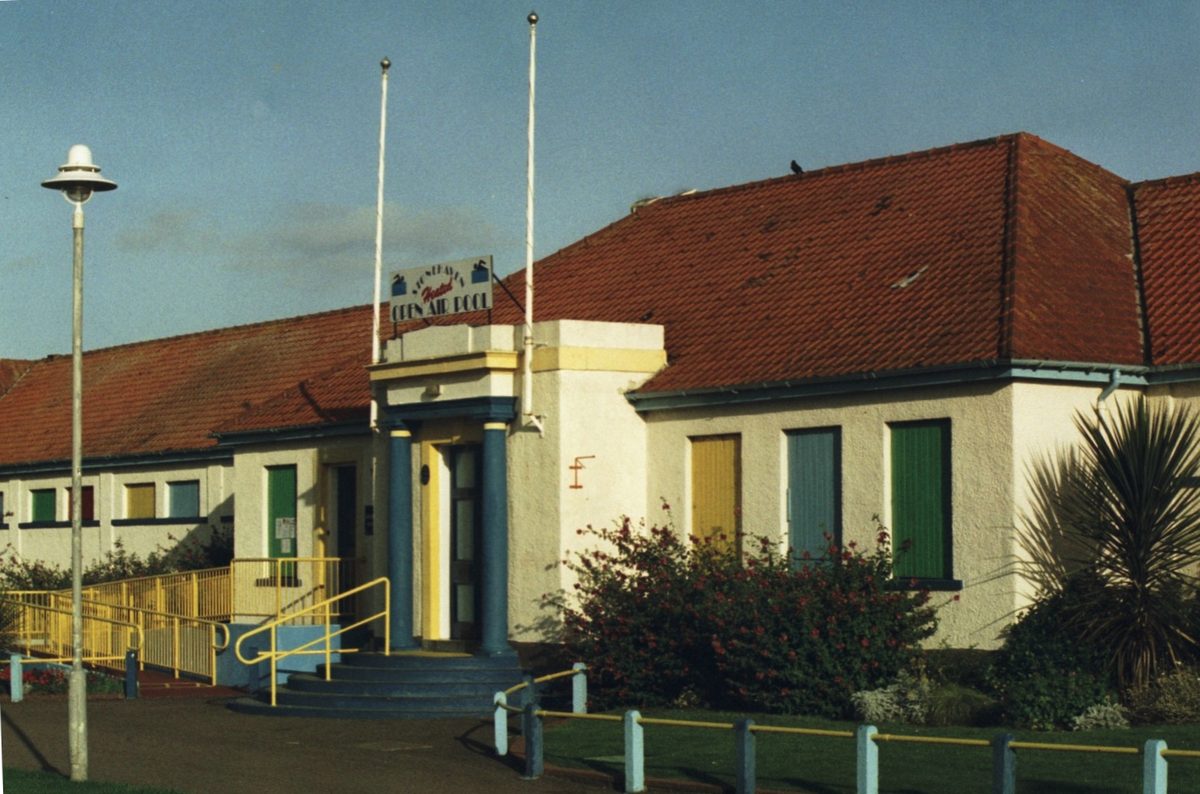
Do not treat Stonehaven as a car park with a town attached. It is a good-looking harbour town in its own right and it turns a two-hour castle visit into a proper day. The heated open-air sea water pool is an art deco lido from 1934, running roughly from late May to early September, and one of the more distinctive swims in Britain. Carron Fish Bar carries the dubious honour of being widely credited as the birthplace of the deep-fried Mars bar, and Aunty Betty’s ice cream shop by the beach has queues in weather that should not produce queues.
If you are in the north east on 31 December, the Stonehaven fireballs ceremony — locals swinging blazing wire cages through the High Street at midnight — is one of the strangest and best New Year traditions in the country, and it appears in our round-up of Scotland’s festivals and events. For what to eat here, Scottish food and drink covers rather more than fried confectionery.
Aberdeenshire’s Castle Trail
Dunnottar is the coastal anchor of a region with more castles per acre than anywhere else in the UK. The Aberdeenshire Castle Trail strings together nineteen of them, and the practical way to use it is to pick two or three rather than the lot. Craigievar is the pink fairytale tower; Crathes has the gardens; Drum has the medieval keep. Deeside runs inland towards Balmoral and Royal Deeside, which pairs with Dunnottar as a two-day loop out of Aberdeen.
If you are comparing which castles deserve your limited days, our ranking of the best castles in Scotland puts Dunnottar in context, and Eilean Donan on the west coast is its closest rival for sheer setting.
Fitting it into a longer trip
Dunnottar sits awkwardly for most first-time itineraries, which run Edinburgh–Highlands–Skye and never come near the north east coast — which is precisely why it is quieter than its fame suggests. The neat solution is to use it as a stop on the drive north via the coast rather than the inland A9. There is a case for that detour in our Edinburgh to Highlands road trip notes and the wider Highland driving routes guide. With ten days or more it slots into a ten-day Scotland itinerary without forcing anything.
What underwhelms, and the mistakes to avoid
The interior is the honest disappointment. People pay £13.50, walk down 180 steps expecting Stirling or Edinburgh, and find grass and roofless walls. The pleasure at Dunnottar is in the position, the scale and the sound of the sea below, not in the rooms. Go in knowing that and you will love it.
The mistakes worth avoiding:
Arriving at 11am in August. Full car park, verge parking, coach parties on the steps, and the flattest light of the day. Move it two hours in either direction and it is a different place.
Not checking the weather that morning. High winds close the castle with very little notice, and people drive from Aberdeen, Dundee and further only to find the gate shut.
Assuming a heritage pass covers it. Historic Environment Scotland membership, the Explorer Pass and National Trust for Scotland cards are all no use here.
Leaving before the north viewpoint. Most visitors walk down, walk round, walk up and drive off, having never stood at the clifftop viewpoint outside the walls. It is a short way further along the clifftop and it is free.
Cutting it too fine at the end of the day. Last entry is an hour before closing, and in the depths of winter that can mean a 2pm cut-off. Check the day’s hours rather than assuming a 5pm close.
Frequently asked questions
How long is the walk from the car park to Dunnottar Castle?
It is short but steep: roughly 300 metres of level path to the clifftop, then around 180 concrete steps down and about 100 more uneven ones back up into the ruin, 283 steps in each direction. Allow longer on the return climb, which comes at the end of the visit when you are already tired.
Is Dunnottar Castle worth the entrance fee?
Yes, if you understand what you are buying. Around £13.50 gets you access to a roofless clifftop ruin of about eleven buildings, not furnished interiors. The value is in walking the site and standing on the rock. If you only want the famous view, the clifftop viewpoint outside the walls is free and arguably better.
Can you see Dunnottar Castle without paying?
You can, and many photographers do exactly that. The car park, the approach path and the clifftop path to the north are all free to use. From there you get the full profile of the castle on its rock, which is the classic postcard view. You only pay if you want to cross onto the rock itself.
Is Dunnottar Castle wheelchair or buggy accessible?
The castle itself is not. There are no lifts or ramps and several hundred uneven steps. However, the roughly 300-metre path from the car park to the clifftop is broadly level, so the main view is reachable, and staff can sometimes permit vehicles down to the turning circle between April and mid-September.
How do you get to Dunnottar Castle without a car?
Take the train to Stonehaven, then either walk the coastal path from the harbour, about an hour each way, or take a local taxi. Stagecoach’s X7 and 107 buses from Aberdeen also stop on the A92 within walking distance of the castle car park. The station is on the main Aberdeen to Dundee line.
Do you need to book Dunnottar Castle tickets in advance?
Generally no. Tickets are sold at the kiosk on the day, though the castle takes card payments only and does not accept cash. Booking online in advance is worth it on summer weekends purely to avoid queuing outdoors. Check the site the morning of your visit in case of weather closures.
Is Dunnottar Castle run by Historic Environment Scotland?
No. It is privately owned and operated by Dunecht Estates, and has been in the Cowdray family since 1919. Historic Environment Scotland membership, the Explorer Pass and National Trust for Scotland cards do not give you entry. Historic Houses members do get in free, which is the one exception worth knowing.
How do you pronounce Dunnottar?
Dun-OTT-er, with the stress on the middle syllable and a soft ending, rather than dun-oh-TAR. The name derives from the Pictish dun, meaning fort or place of strength, and probably began as Dun Fother, roughly the fort in the low country.
Final thoughts
Dunnottar Castle is the rare famous place that is better than its photographs and also less than them, depending on which bit you are talking about. The rock, the setting and the light off the North Sea deserve every superstar image ever taken of them. The ruin on top is a good ruin, no more, and it will not detain you for long.
Go early or go late. Wear boots. Check the wind before you leave. Walk out from Stonehaven if your legs allow it, because the approach along the cliffs is half the pleasure. And whatever else you do, keep going north along the clifftop after you climb back up, and give yourself ten minutes at the viewpoint with the castle side-on and the sun behind you. That is the memory you will keep, and it is the one part of the day that costs nothing at all.
About the author: This guide was written and is maintained by the ScotlandTourism.org editorial team — travel writers who’ve spent years exploring Scotland’s cities, Highlands and islands, from bagging Munros to chasing the perfect dram. We update our guides regularly to keep prices, opening details and advice current.
Last updated: October 2026. Prices and opening times change — always check the official site before you travel.
Photo credits
All images are used under their respective Creative Commons or public-domain licenses:
- Dunnottar Castle on its clifftop rock near Stonehaven, with the approach path and… — Mimihitam, CC BY-SA 3.0, via Wikimedia Commons
- Boats in Stonehaven harbour, the starting point for the coastal walk to Dunnottar Castle — Andrew Tryon, CC BY-SA 2.0, via Wikimedia Commons
- The unfinished stone temple of Stonehaven war memorial on Black Hill, passed on the… — Stanley Howe, CC BY-SA 2.0, via Wikimedia Commons
- Dunnottar Castle at dusk from the northern clifftop, the best light for photographs — Bex-Lemon, CC BY-SA 4.0, via Wikimedia Commons
- Dunnottar Castle on its conglomerate rock with the North Sea on three sides — Lynette and Malcolm Johnson, CC BY-SA 2.0, via Wikimedia Commons
- The art deco frontage of Stonehaven’s heated open-air sea water pool — Alan Cooper, CC BY-SA 2.0, via Wikimedia Commons
- Dunnottar Castle seen in low light from the coast path north of the castle, the free… — Nigel Corby, CC BY-SA 2.0, via Wikimedia Commons
- Roofless buildings inside Dunnottar Castle looking down over Castle Haven bay — William Marnoch from Cambridge, UK, CC BY 2.0, via Wikimedia Commons