Plenty of people do Stirling Castle badly. They pay, walk round quickly, photograph the view, decide it is smaller than Edinburgh Castle and drive on towards Glencoe. By the time they leave, they have walked straight past a royal palace restored to how it looked in the 1540s without once thinking to look up.
That is the trap here. The place looks like a fortress and photographs like a fortress, so people treat it as one — a lap of the walls, a picture, back down the hill. It is actually a Renaissance palace with a fortress wrapped round it, and the two halves of the story only lock together once you understand why anyone bothered to build on this particular rock in the first place.
Is Stirling Castle worth visiting?
Yes, and give it more time than you expect. The Royal Palace interiors recreate royal life in the 1540s: painted chambers, a replica carved ceiling and seven hand-woven wall hangings. Allow two and a half to three hours. Adult admission is around £18.50 booked online at the time of writing.
Stirling Castle at a glance
| Detail | What to expect |
|---|---|
| Where | Castle Wynd, Stirling FK8 1EJ — top of the Old Town, about half a mile uphill from the train and bus stations |
| Adult admission | Around £18.50 online, around £20.50 at the gate at the time of writing; free to Historic Environment Scotland members and Explorer Pass holders |
| Opening times | Daily 9.30am–6pm from 1 April to 30 September; 9.30am–5pm from 1 October to 31 March. Last entry one hour before closing |
| How long to allow | Two and a half to three hours for the full site; ninety minutes if you are tight and prepared to cut |
| Highlight | The Royal Palace — the King’s and Queen’s apartments, the Stirling Heads and the Hunt of the Unicorn hangings |
| Best for a wet day | Very good. A large share of the site is under a roof, unlike most Scottish castles |
| Getting there without a car | Direct trains from Edinburgh (around 50 minutes) and Glasgow (around 35 minutes), then a half-mile walk uphill |
| Managed by | Historic Environment Scotland |
The history that actually matters here is geography
Almost every guide to Stirling opens with William Wallace, and I understand why — there is a 220-foot Victorian tower to his memory staring back at you from across the valley. But Wallace is a consequence of Stirling, not a cause. The cause is the ground.
The lowest bridge on the Forth
Look north from the castle walls and you are looking at the carse, the flat alluvial floodplain of the River Forth. For centuries that plain was boggy, tidal and effectively impassable to an army. The Forth widens eastward into a firth you cannot cross without a fleet. West of Stirling the land climbs into the Trossachs and the southern Highlands.
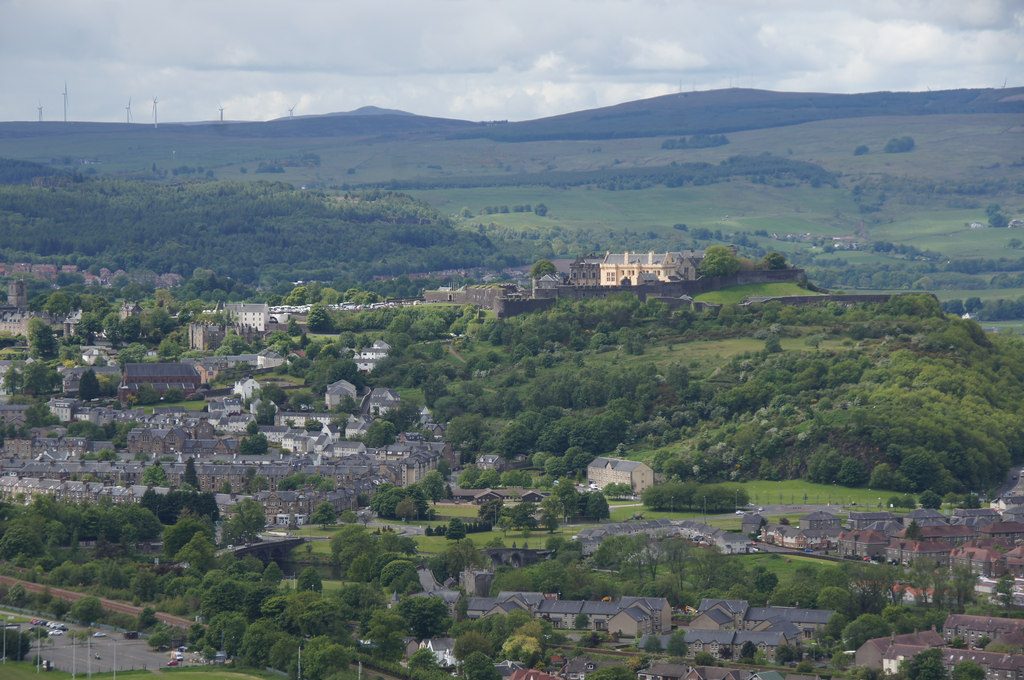
Which left one gap. Stirling sat at the lowest bridging point on the Forth — the furthest downstream you could get an army with baggage and horses across dry-shod — and it stayed the main crossing until the early 1800s. The surviving stone bridge below the castle dates from around 1500 and replaced earlier timber structures on roughly the same line.
So if you were moving between the fertile Lowlands and the mountains to the north, you came through Stirling. And the rock above the crossing is a dolerite crag left by a volcano and scraped clean on three sides by glaciers, with a long tail of softer rock running away to the south-east. Sheer cliffs on three flanks, one gentle approach that you can fortify, and a commanding view over the only road worth having. If you had to design a castle site from scratch you would design this one.
Stirling Bridge, 1297, and Bannockburn, 1314
Once you have grasped the crossing, the two most famous battles in Scottish history stop being a coincidence of geography and start looking inevitable. Both were fought within a couple of miles of the castle, and both were fought over it.
At Stirling Bridge in September 1297, Wallace and Andrew Moray let part of an English army file across a narrow timber bridge onto the boggy north bank, then cut it in half. It is a battle you can only understand by standing above the site and seeing how little firm ground there is. Seventeen years later, in June 1314, Edward II marched north specifically to relieve the English garrison holding Stirling Castle, which had agreed to surrender unless it was relieved by midsummer. Robert the Bruce met him on the soft ground south of the town at Bannockburn.
During the Wars of Independence the castle is reckoned to have changed hands eight times in fifty years. Nobody was fighting over the buildings. They were fighting over the crossing.
What to look for from the ramparts
Give yourself ten minutes on the north-facing walls near the Queen Anne Garden and pick out four things in order. The dark tower on the wooded hill to the north-east is the National Wallace Monument on Abbey Craig, roughly where Wallace’s men waited in 1297. Below and left of it, the loops of the Forth curl through flat fields — those meanders are why the plain was useless to cavalry. Almost directly below the walls you can pick out the old stone bridge. And on a clear day the Ochil Hills run away east while the Highland edge rises to the north-west; the geological boundary is genuinely visible from here.
That is the whole argument of the castle in one view, and it is free with your ticket. It is also, for my money, a better introduction to Scottish history than anything you will read on a display board. If castles are the reason you are coming at all, our overview of castles in Scotland sets Stirling in context alongside the rest, and there is a ranked run-through in our guide to the best castles in Scotland if you are choosing between them.
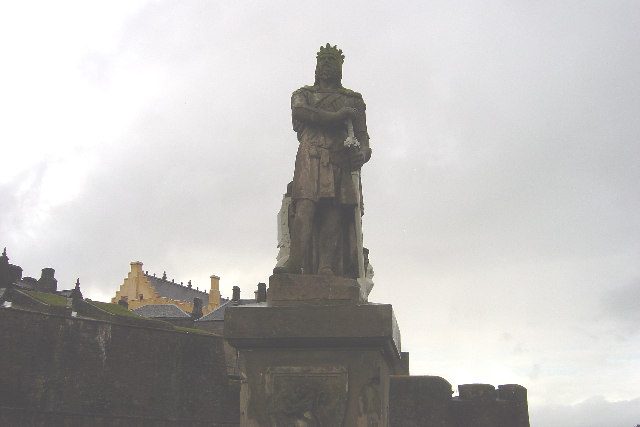
The Royal Palace, and why nobody knows what they are looking at
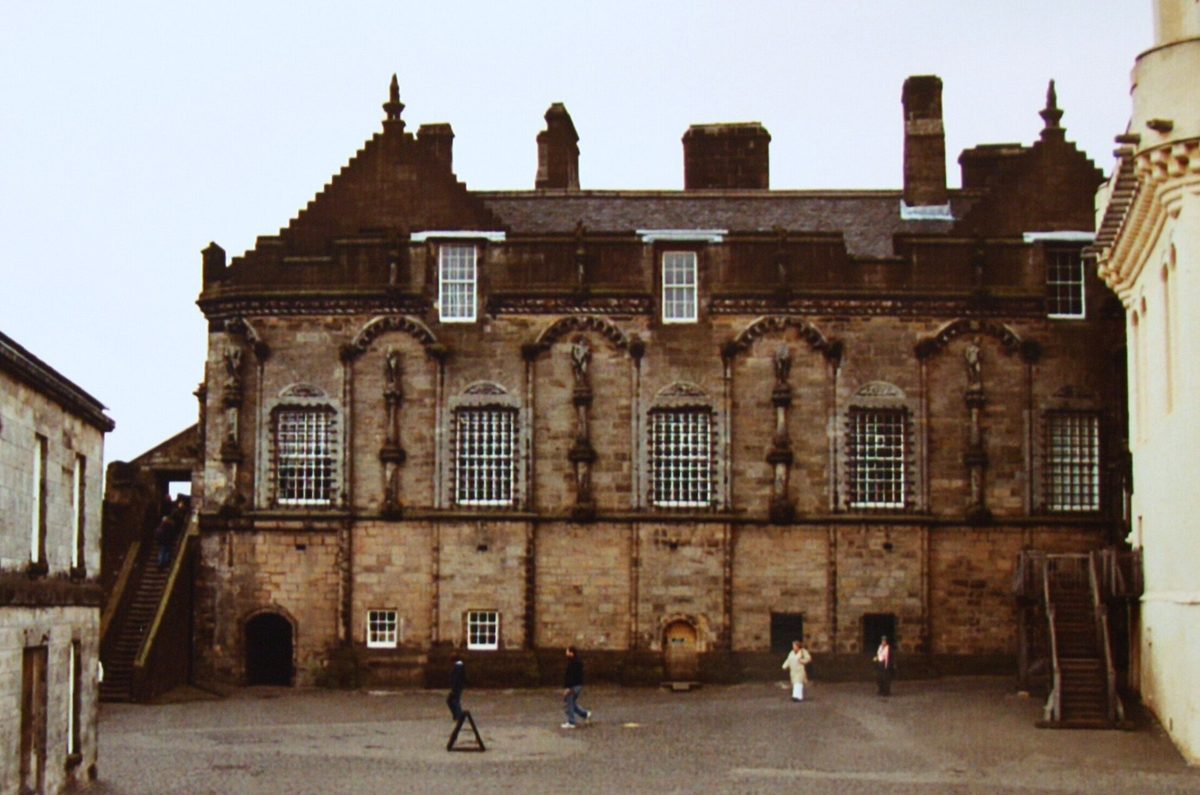
Here is the thing almost every visitor misses. The Royal Palace at Stirling — the square block on the south side of the Inner Close, with the carved figures standing on twisted columns along its outside walls — was built for James V between roughly 1538 and 1542, and it is one of the earliest and most ambitious Renaissance buildings in Britain. By the twentieth century it was an empty shell. The army used the castle as a barracks from 1800 and as a regimental depot from 1873, and the interiors had been stripped out long before.
What you walk through today is the result of a restoration project that cost in the region of £12 million and reopened to the public in June 2011. Six apartments were furnished and decorated as the research suggested they had looked around 1540. That date matters, because it is the reason the rooms look wrong to modern eyes.
Why the colours look so loud
Walk into the King’s Presence Chamber and your first reaction will probably be that somebody has overdone it. Deep crimson walls, gold, blue, green, a ceiling like a jewellery box. It looks like a film set.
It is not. The muted image most of us carry of a castle interior — grey stone, dark oak, one faded hanging, a suit of armour in a corner — is a Victorian invention, a nineteenth-century idea of the Middle Ages layered on top of buildings that had faded and been stripped bare. A working Renaissance court was loud. Colour was expensive, pigment was imported, and a king spent money on it precisely so that visiting ambassadors would notice.
Once that clicks, the palace becomes far more interesting. You are not looking at a heritage attraction’s guess at atmosphere; you are looking at an argument, backed by paint analysis and inventories, about what wealth looked like in 1540. Whether you find it convincing is up to you. I do, and I think it is the single best reason to choose Stirling over the more famous alternative — a comparison we set out properly in Stirling Castle versus Edinburgh Castle.
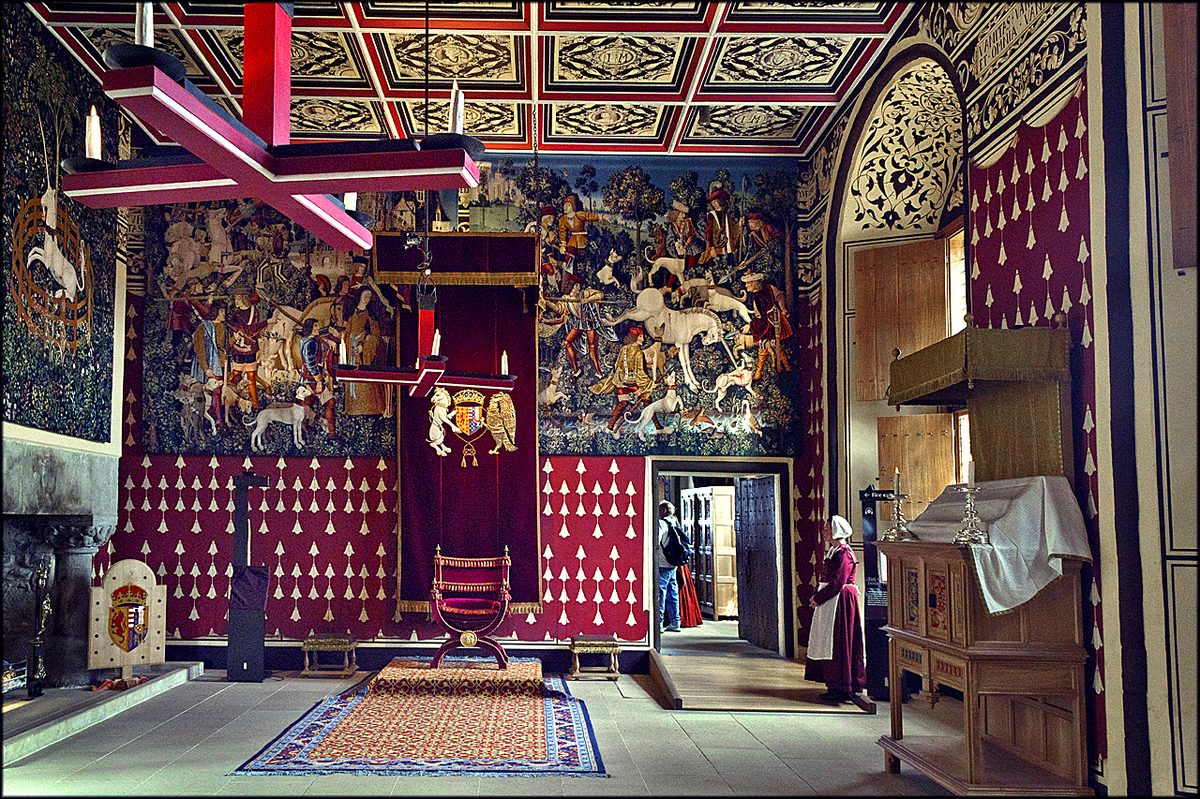
The Stirling Heads
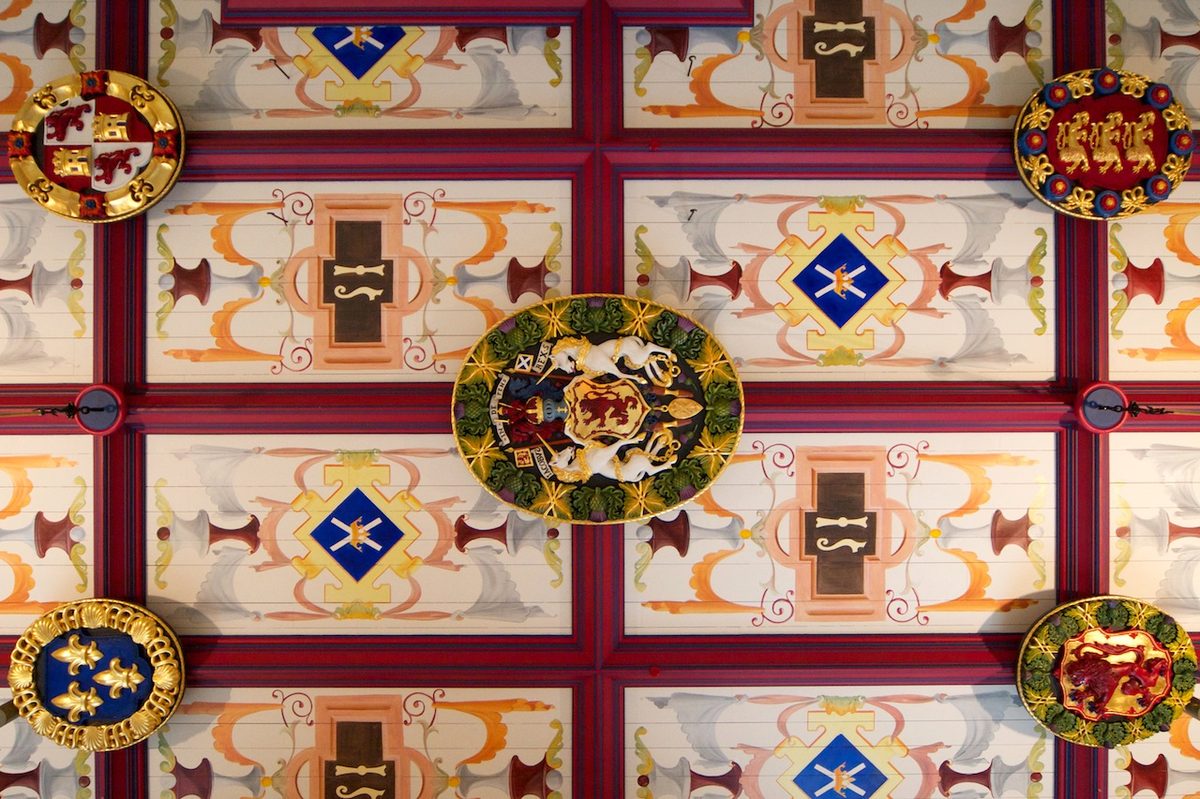
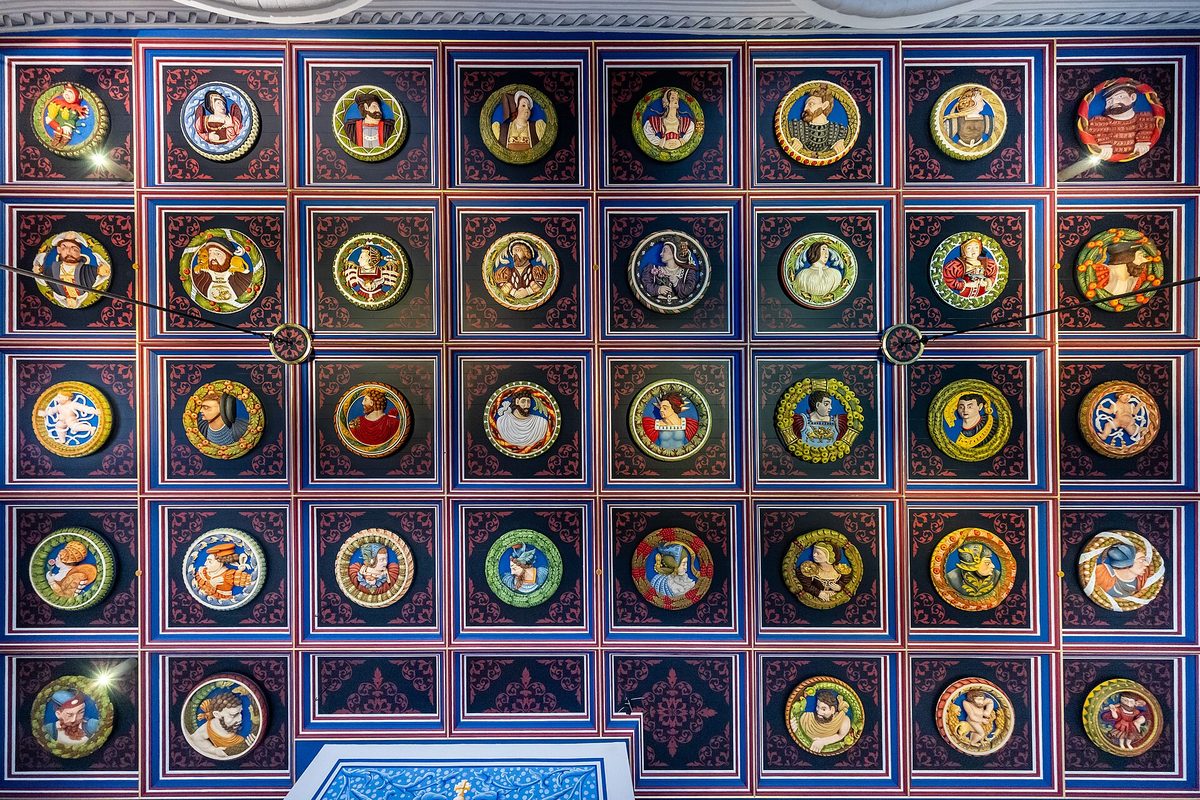
Look up in the King’s Presence Chamber and the ceiling is set with carved oak roundels about a metre across, each bearing a face: Scottish kings and queens, Roman emperors, biblical and classical figures, court personalities. These are the Stirling Heads, and they are sometimes described as Scotland’s other crown jewels.
The ones over your head are replicas. The original ceiling came down in 1777 and the surviving carvings were scattered; the reproductions were cut by the carver John Donaldson over five years, and the ceiling now holds thirty-seven heads, one of them newly designed rather than copied. The originals — battered, unpainted, far stranger than the copies — are displayed at eye level in the Stirling Heads Gallery on the floor above.
Do both, in that order, and give the gallery a proper twenty minutes. Seeing the bright replica ceiling first and then meeting the worn originals face to face is one of the most quietly effective pieces of interpretation I have come across at any Scottish site. Most people rush the gallery because it looks like a room full of wooden discs. It is not.
The Hunt of the Unicorn hangings
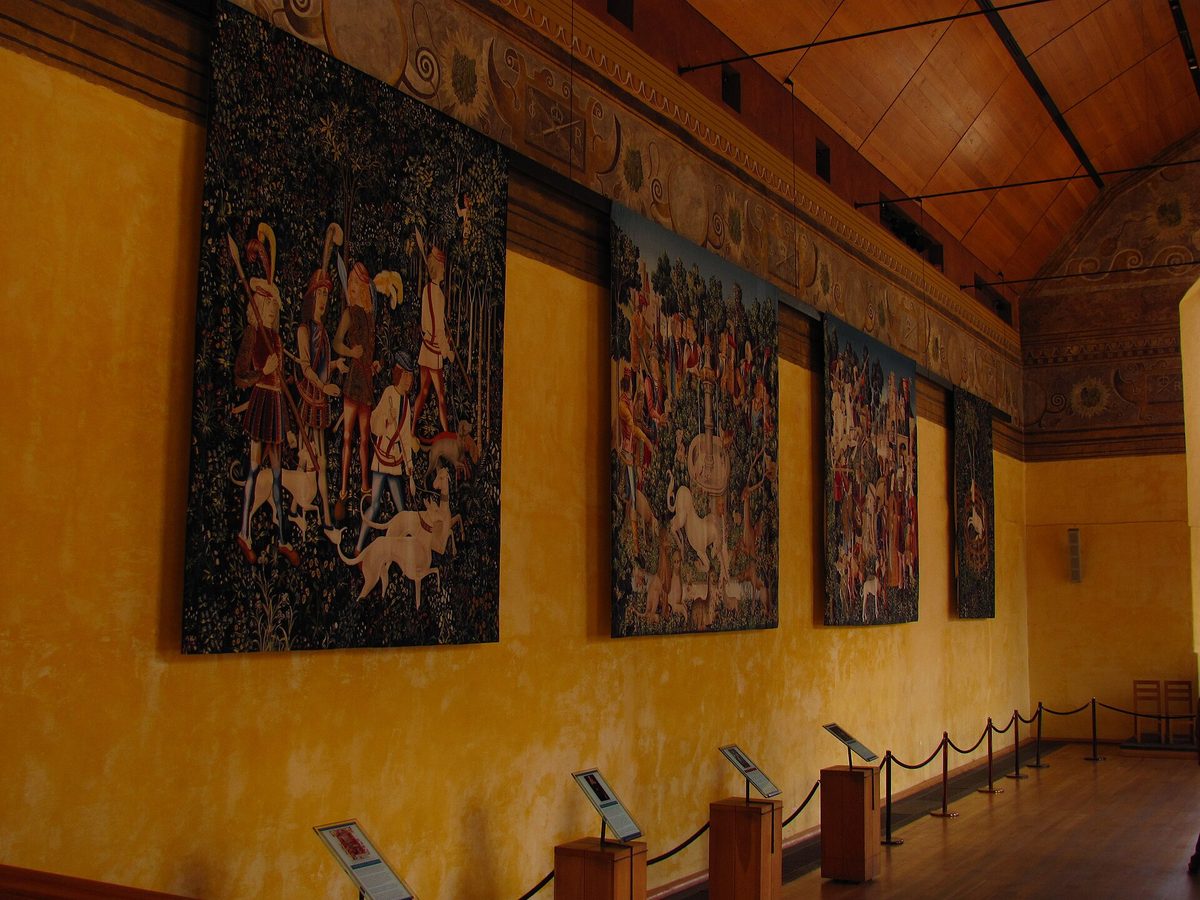
The seven large woven hangings in the Queen’s apartments are recreations of the late-medieval Hunt of the Unicorn series, the originals of which hang at The Cloisters in New York. Historic Scotland commissioned them, and the last one was finished in 2015 — thirteen years of work on a West Dean Tapestry Studio project that involved 18 international weavers. West Dean calls it the biggest weaving project undertaken in the UK for 100 years.
Stand close. You can see the weave, the slits, the deliberate imperfections. And the unicorn is not decoration: it is the Scottish royal beast, which is why you will see the animal everywhere from the café sign to the castle’s own badge.
The Palace Vaults
Under the palace is a set of vaulted chambers turned over to hands-on displays — costumes, instruments, things to touch and smell, organised around the trades that served a royal court. It is aimed squarely at children and it works. If you are travelling as a family, this and the Great Kitchens are the two rooms that will buy you goodwill; there are more ideas along those lines in our guide to things to do in Scotland with kids.
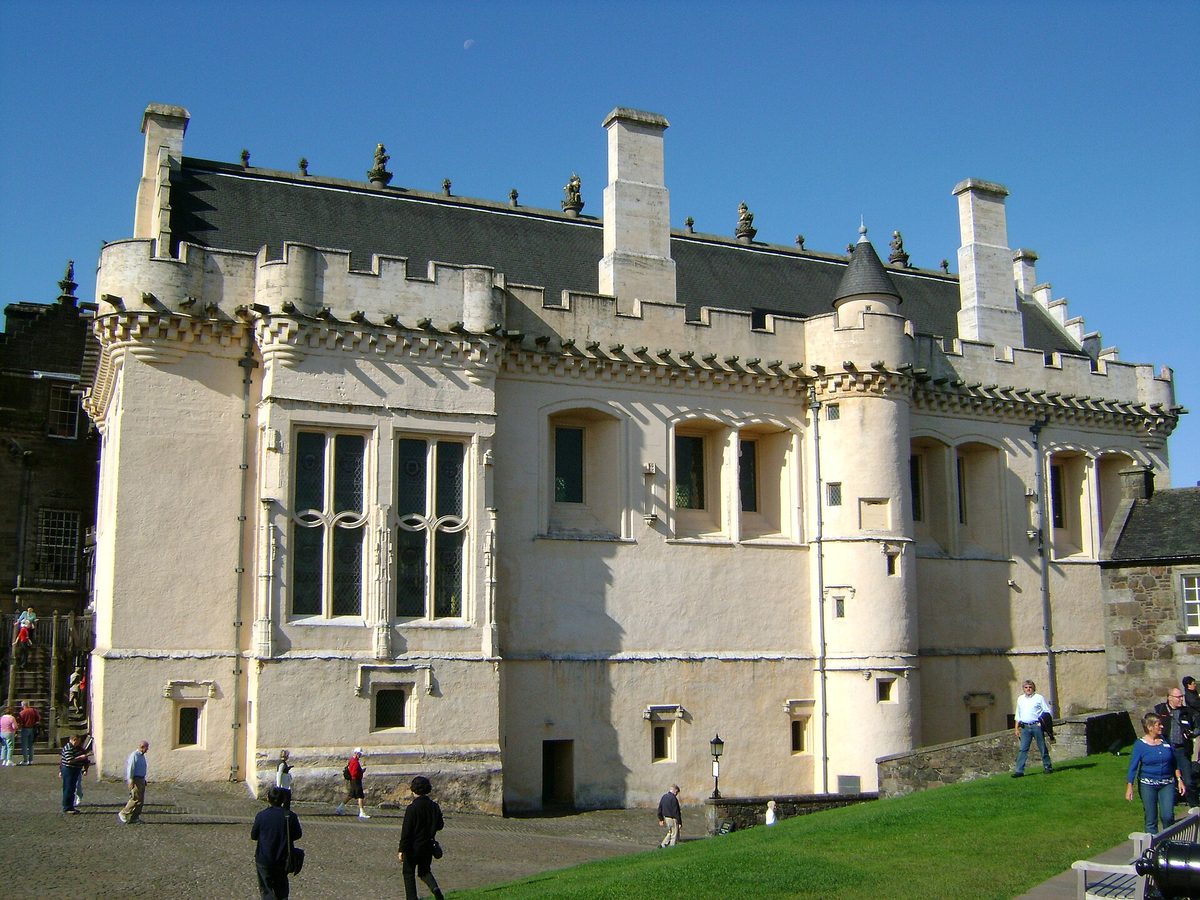
The rest of the site, building by building
The Great Hall and its very argumentative limewash
The long building on the east side of the Inner Close is the Great Hall, built for James IV in the early 1500s. It has a hammerbeam roof, five fireplaces and, from the outside, a colour that stops people in their tracks: a strong yellow ochre limewash usually called royal gold.
This caused a proper row. The hall was restored through the 1990s and reopened in 1999, and the decision to render and limewash the exterior was attacked at the time as gaudy and inauthentic. The conservators’ answer was that traces of the original sixteenth-century limewash survived on the stone, and that the whole point of the colour was to be seen from a distance — a golden block on a black crag, visible for miles as a statement of who owned the crossing.
I have come round to it. On a grey day it is the only warm thing in the whole complex, and it makes the point about Renaissance taste that the palace interiors make indoors. Scotland has quietly gone the same way elsewhere: harled and limewashed buildings that spent a century as bare grey stone have been returned to ochre and pink at several sites since.
The Chapel Royal
James VI had the Chapel Royal built in 1594 for the baptism of his son Prince Henry, and had it up in a matter of months — the deadline was the christening. It replaced an older chapel on a slightly different alignment, and it is a calm, wide, well-lit room after the intensity of the palace.
The thing to look for is the painted frieze high on the walls, added in 1628 by the decorator Valentine Jenkin ahead of a royal visit by Charles I. It is faded and easy to miss, and it is one of the few surviving schemes of its kind in Scotland. The older chapel that stood nearby is where Mary Queen of Scots was crowned in September 1543, at nine months old.
The Great Kitchens
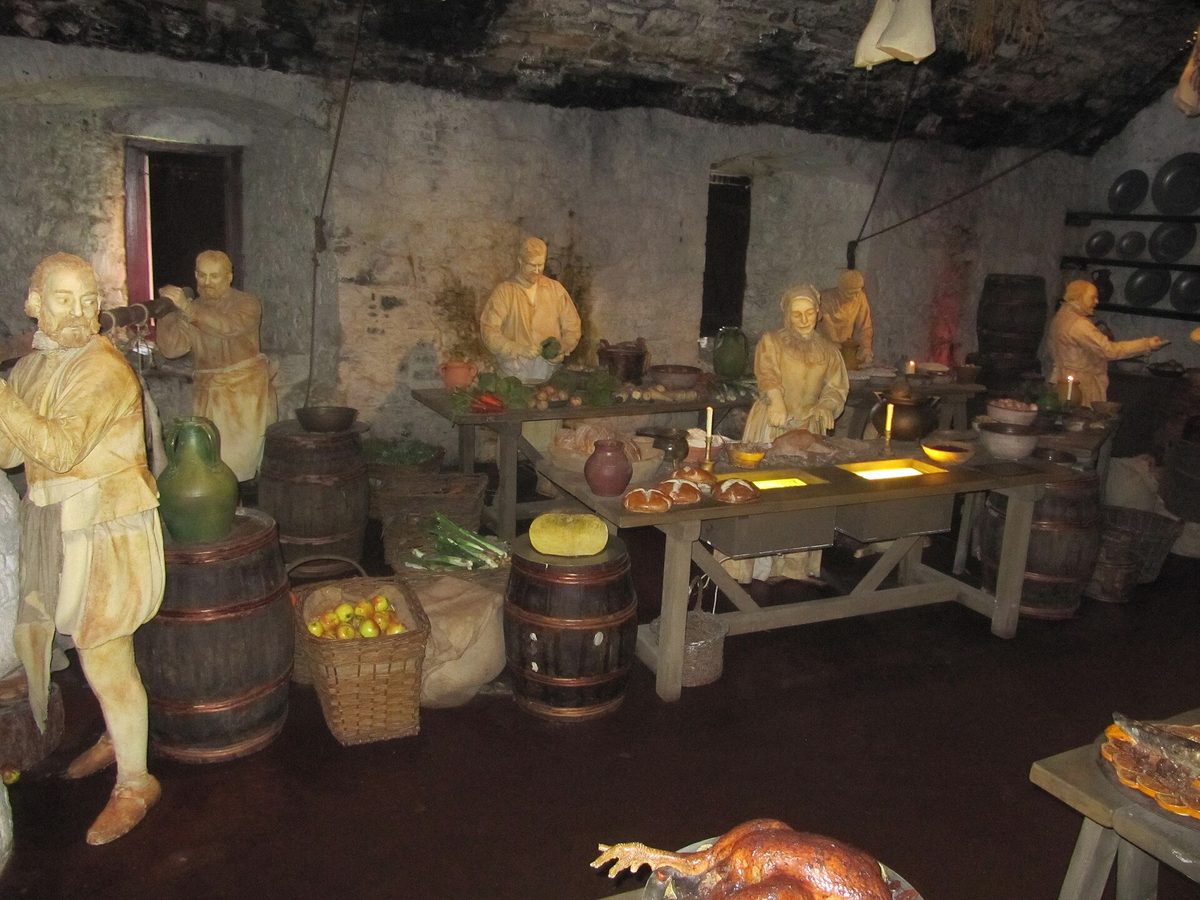
Down a flight of steps from the Outer Close, the Great Kitchens are staged as though a banquet were mid-preparation: model cooks, barrels, a plucked bird on a board, cheeses, bread. It is unashamedly theatrical and it is also the room where you learn the most about how a court actually functioned, because the scale of it is the point. Feeding several hundred people from open fires is a logistical operation, and you can see the whole chain from delivery to serving hatch.
Allow twenty minutes. Note that the access is down several steps, which matters if you have mobility issues.
The Argyll and Sutherland Highlanders Regimental Museum
Housed in the King’s Old Building at the top of the site, this is a genuine regimental museum — medals, colours, uniforms, campaign relics, family stories — and it is run independently of the castle. It is included in your admission.
Two practical warnings. It closes forty-five minutes before the rest of the castle, so it is the first thing to fall off your plan if you arrive late in the day. And there are a great many stairs: several flights, well over a hundred steps in total across the galleries. If military history leaves you cold, this is the honest candidate for skipping. If it does not, budget half an hour.
The Queen Anne Garden, the ramparts and the Nether Bailey
The small walled garden below the palace is a pleasant, level loop with a very old beech tree and the best angle on the palace’s carved south front. The rampart walk gives you the views described earlier. Down at the far north end is the Nether Bailey — a grassy open area reached down a cobbled track, with a different view up the Forth. If the Inner Close is heaving with a coach party, walk down there for ten minutes and let it clear.
The King’s Knot, below the walls
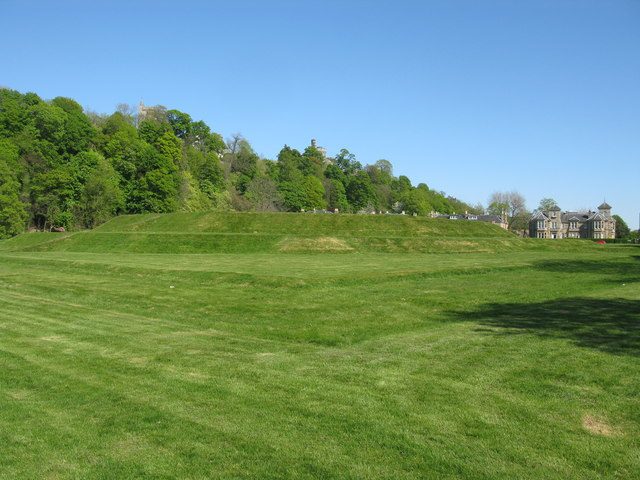
From the western ramparts, look down into the King’s Park and you will see a set of grassed earthwork terraces in a stepped octagonal shape. That is the King’s Knot, the surviving shape of a formal royal pleasure garden laid out in the 1620s on ground that had been used for royal recreation long before.
You cannot appreciate it from ground level — it just looks like lumpy grass — which is precisely why you should look at it from above first, then walk down afterwards if you have time. It is free and open year-round, and you reach it on foot from below the castle.
A route round the castle that actually works
The site is not laid out in an obvious sequence and there is no enforced one-way system beyond the palace itself, so most people wander and double back. Here is the order I would use.
The full loop, two and a half to three hours
Come in through the forework and stop in the Outer Close. Get your bearings, then do the Great Kitchens first while your legs are fresh and before the mid-morning crowd arrives — twenty minutes. Back up to the Great Hall, fifteen minutes, and note the roof.
Through to the Inner Close for the Chapel Royal, ten to fifteen minutes. Then the Royal Palace, which is the heart of it: forty-five minutes to an hour including the Stirling Heads Gallery upstairs. Do not rush this; it is what you came for, even if you did not know it.
Then the Regimental Museum if it appeals, half an hour. Then the ramparts and Queen Anne Garden for the views and the geography, twenty minutes. Finish with the Palace Vaults if you have children in tow, or the Nether Bailey if you do not. Café and shop on the way out.
The ninety-minute version
If you have a train to catch or you are squeezing this into a day trip, cut hard and cut early. Do the Royal Palace and the Stirling Heads Gallery properly — a full hour, no compromise. Give the Great Hall ten minutes and the Chapel Royal five. Spend the last fifteen on the north ramparts working out the landscape.
Skip the Regimental Museum, skip the Great Kitchens, skip the Nether Bailey and the Palace Vaults. Skip the shop. You will have seen the things that make Stirling different from every other castle in the country, which is more than most people manage in three hours. Day-trippers coming up from the capital will find the timings for the whole outing in our round-up of day trips from Edinburgh.
Tickets, opening times and what it costs
Prices
At the time of writing, Historic Environment Scotland lists adult admission at around £18.50 booked online in advance and around £20.50 bought at the gate. Concessions for over-65s are £15 online, children aged 7 to 15 £9 online, and under-7s go free. Family tickets exist. Prices move most years, so check the official site before you travel.
Two things worth knowing. First, booking online is not just cheaper, it also guarantees entry on busy days. Second, there is a car-free discount: book online with the relevant promotional code and arrive by bus, train or bike with your ticket to show, and you get 25 per cent off the standard admission. That is a meaningful saving on a family booking and it makes the train from Edinburgh or Glasgow look very sensible indeed.
Opening times
From 1 April to 30 September the castle opens daily at 9.30am and closes at 6pm. From 1 October to 31 March it opens at 9.30am and closes at 5pm. Last entry is one hour before closing in both seasons, which is a real constraint rather than a formality — at 4pm in November you will not see the site properly.
It is closed on 25 and 26 December, closes early on Christmas Eve, and opens late on New Year’s Day. The Regimental Museum shuts forty-five minutes before everything else, and the café keeps its own slightly shorter hours.
Membership, the Explorer Pass and audio guides
Historic Environment Scotland members go in free, as do Explorer Pass holders. If Stirling is one of several HES properties on your trip — and it usually is, given how many there are — do the arithmetic before you buy single tickets, because two or three sites will often cover the cost of a short-term pass. Our notes on planning the wider trip in how to plan a trip to Scotland cover which passes tend to pay for themselves.
An audio guide costs around £3 for adults at the time of writing and is available in English, Gaelic, French, German, Spanish, Italian, Japanese and Mandarin, with 20 per cent off for Explorer Pass holders buying in person. There is also a paid behind-the-scenes tour that takes small groups through areas normally locked off; it runs twice a day, lasts about ninety minutes, is not suitable for under-12s or anyone uneasy with heights, and costs considerably more because admission is bundled in. Book that one well ahead.
The free guided tours are the best thing on the ticket
This is the tip I would most like you to act on. Guided tours are included in your admission. Ask at the entrance when the next one leaves and where it meets, and join the earliest you can.
The guides at Stirling are unusually good — several of them are local, opinionated and funny, and they will happily take questions. More to the point, a guided talk at the start turns the rest of your visit from a walk round some old buildings into something you can actually follow. Ask at the gate when the next tour leaves and join one early in your visit.
Getting there, and where to leave the car
By train from Edinburgh and Glasgow
Stirling is one of the easiest big attractions in Scotland to reach without a car. Direct trains from Edinburgh Waverley take around 50 minutes and from Glasgow Queen Street around 35, with several an hour for much of the day. Buses run too and are cheaper, if slower. Combine that with the car-free admission discount and the case for leaving the car behind is strong — something we make in more detail in our Scotland without a car itinerary and in our general primer on getting around Scotland.
The walk up from the station
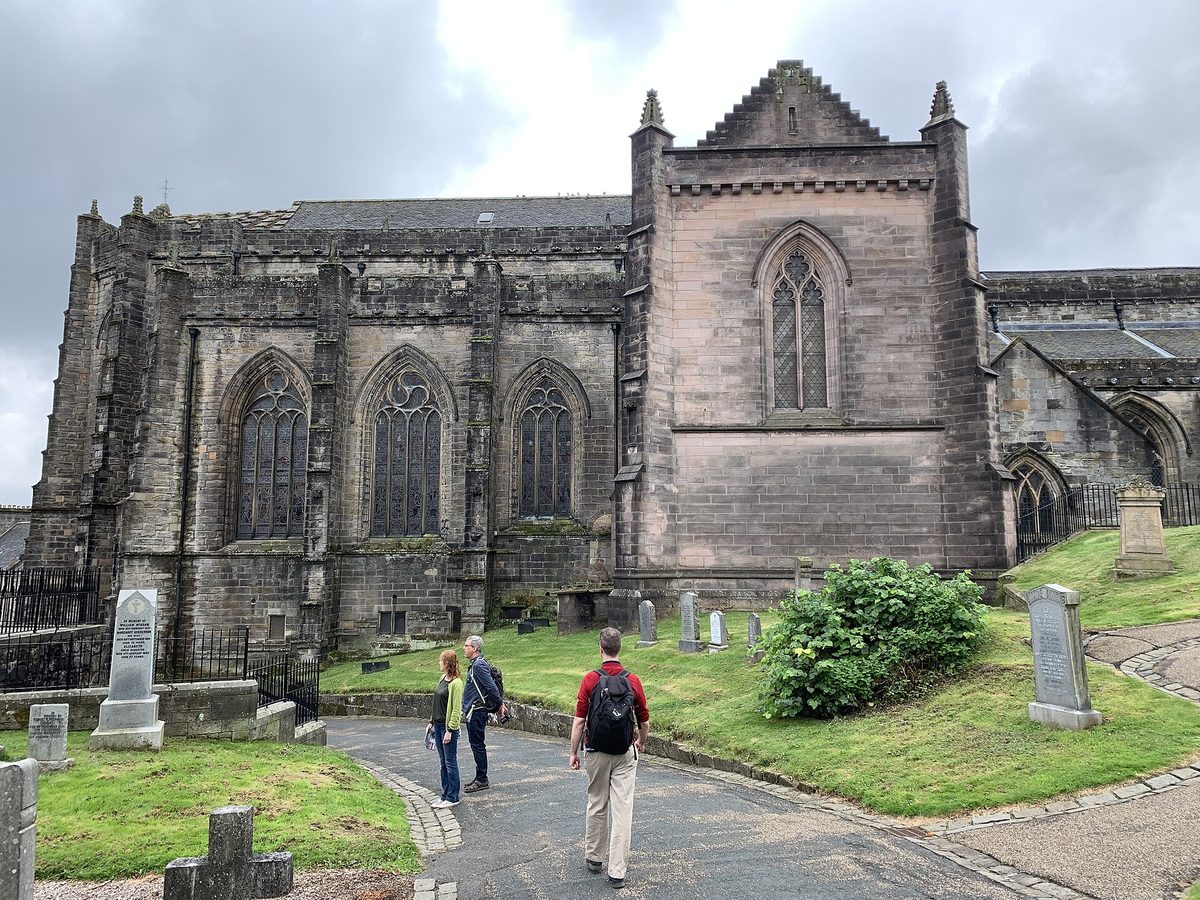
The castle is about half a mile from the train and bus stations, and every inch of it is uphill. It is about half a mile uphill: take it at a steady pace, and allow extra time if you stop and considerably more with a suitcase. The route runs up through the Old Town past Mar’s Wark and the Church of the Holy Rude, which is no hardship at all — it is one of the better half-miles of streetscape in Scotland.
If the hill is a problem, do not count on the Castleview Park and Ride bus to solve it: it runs between Castleview and the city centre for a pound or so return, which still leaves you the walk up through the Old Town. It does not run on Sundays, which catches people out.
Driving and parking
The castle car park is closed to all vehicles except coaches and those needing accessible parking. Check the official Stirling Castle plan-your-visit page the week you travel in case that changes.
The honest advice: do not plan on it. Either use the Castleview Park and Ride off junction 10 of the M9 (postcode FK9 4TW), where the return bus costs about a pound, or leave the car in one of the town centre car parks, which put you at the bottom of the Old Town walk. There is no parking at all for caravans, trailers or motorhomes, and coach bays on the esplanade are limited.
When to go, weather and getting around the site
The quiet hours
Stirling is busy but nothing like Edinburgh Castle, which is one of its great advantages — the ticketing pressures at the capital’s fortress are a different order of problem, as our Edinburgh Castle tickets guide explains. Here, the crush is coach-shaped rather than constant.
So: be at the gate for opening at 9.30am, or come after 3pm in summer when the last of the tours has gone through and the light on the Great Hall is at its best. Midweek beats weekends. April, May, September and October are the sweet spots — our month-by-month notes on Scotland in October and the broader best time to visit Scotland go into the trade-offs between crowds, daylight and weather.
Is it any good in the rain?
Yes, and this is genuinely one of the best wet-weather attractions in central Scotland. The Royal Palace, the Stirling Heads Gallery, the Great Hall, the Chapel Royal, the Great Kitchens, the Regimental Museum and the Palace Vaults are all indoors. You will get wet crossing the courtyards and you will lose the views, but you will not lose the visit.
Compare that with an exposed coastal ruin, where rain simply ends the day. If you are building a wet-weather reserve list for a trip, Stirling belongs on it — alongside the indoor options in our guide to free things to do in Scotland for the days when the forecast collapses entirely.
Cobbles, gradients and accessibility
Be realistic about this one. The approach from the town is cobbled and sloping, and the main route from the gate to the Inner Close is 160 metres of cobbles with a maximum gradient of about 1 in 9. Cobbles plus slope is hard work in a wheelchair and unpleasant in the wrong shoes.
Historic Environment Scotland does a decent amount to help. There is a mobility vehicle to the Inner Close, available on request at the entrance, though it depends on staff being free so there can be a wait. A handful of manual wheelchairs can be borrowed on a first-come basis. There are adapted toilets in the first courtyard and by the Great Hall. Carers go free, up to two per booking, and proof of disability is not required. Ear defenders can be borrowed, and there is a visual story guide published for autistic visitors.
The buildings vary a lot. The Great Hall and Chapel Royal have level access from the courtyard and the garden path is level paving. The Great Kitchens are down several steps. The Regimental Museum has steps at the entrance and many more inside. The Nether Bailey involves a 200-metre cobbled track with a steep downhill gradient. Plan the visit around the flat bits and you will still see the best of it.
One more practical note: suitcases and large rucksacks of 30 litres or more are not allowed in, and there is no left luggage. If you are arriving off a train mid-journey, sort your bags first.
What to combine it with
Within ten minutes’ walk
The Old Town below the castle is badly under-visited and it is where I would spend a spare hour rather than adding a second castle. The Church of the Holy Rude is the standout: James VI was crowned there in July 1567. Tourist entry in 2026 is £7.50 for adults and £6 for concessions, with children 16 and under free, and the medieval roof is worth the detour on its own.
Argyll’s Lodging, a short way down Castle Wynd, is often called the finest surviving town house of its period in Scotland; public access has been intermittent in recent years, so check before you build a plan around it. Mar’s Wark, the ruined facade of an unfinished Renaissance mansion, sits on the same street and costs nothing to look at. The Old Town Jail runs costumed tours of a Victorian prison and is the best option in Stirling if you are travelling with older children who have had enough of gilded ceilings.
Across the valley
The National Wallace Monument on Abbey Craig is the obvious pairing, and after the ramparts you will understand exactly why it stands there. It is a separate ticket, and the climb up the internal spiral stair is genuinely steep — well over two hundred steps — but the view back to the castle is the best you will get.
The National Trust for Scotland’s Bannockburn visitor centre is closed for renovations and due to reopen in mid-2028, but the memorial site stays open, and the monument and the Bruce statue are, honestly, the more moving part anyway. Stirling Old Bridge below the town is free and open year-round to walkers and cyclists. Cambuskenneth Abbey, a mile away over the river, is a quiet ruin with a royal grave and almost nobody in it.
Within an easy drive
Doune Castle, a short drive north-west, is the one to add if you want a contrast: a late medieval courtyard castle with a gatehouse tower, restored in the 1880s and famous as a filming location, with none of Stirling’s colour and all of its atmosphere. The Kelpies at Falkirk are half an hour east. Loch Lomond is under an hour west, and there is plenty to fill a day there in our guide to Loch Lomond and the Trossachs.
Stirling also works well as a first stop when you are heading north out of the central belt — it sits neatly on the route described in our Edinburgh to Highlands road trip, and slots into most versions of a week-long Scotland itinerary without costing you a night. If you want the west-coast castle that everyone photographs as a counterweight to Stirling’s interiors, that is Eilean Donan, three hours further north-west.
What underwhelms, and the mistakes people make
Let me be even-handed, because no attraction deserves an unbroken run of praise.
The outside of the castle is the least impressive thing about it. From most angles the complex reads as a jumble of grey blocks and later barracks, and the profile from the town is nothing like as theatrical as Edinburgh’s. If you have come for the photograph, you will be mildly disappointed; the best exterior shots are taken from Abbey Craig or the King’s Park, not from inside.
The costumed interpreters divide people. When they are good they are excellent, and when the palace is busy they can be hard to escape. If you want to look at a room in silence, you may have to wait for a group to move through.
The café is fine rather than good. Stirling’s Old Town has better and cheaper options five minutes downhill, and if food is part of the day out, our guide to Scottish food and drink is a better use of your appetite than a queue for a sandwich.
As for mistakes: the big one is under-budgeting time. Ninety minutes is survivable, two hours is standard, but three hours is what the site actually deserves. The second is arriving late in the afternoon in winter and finding last entry has passed. The third is driving up and assuming you will park — that assumption fails regularly in July and August. The fourth, and the reason I wrote this guide the way I did, is spending the visit at eye level. Look up. The ceilings are the point.
One that is less obvious: people treat Stirling as an afterthought bolted onto an Edinburgh day and give themselves ninety minutes including two hours of travel. If that is your plan, either accept the cut-down route above or give Stirling its own half-day. There are more general timing pitfalls of this kind in our first time in Scotland tips.
Frequently asked questions
How much are Stirling Castle tickets?
At the time of writing, adult admission is around £18.50 if you book online in advance and around £20.50 at the gate. Online, over-65s pay £15 and children aged 7 to 15 pay £9, while under-7s are free. Historic Environment Scotland members and Explorer Pass holders enter free. Always check the official site, as prices are reviewed regularly.
What are Stirling Castle’s opening times?
From 1 April to 30 September it opens daily 9.30am to 6pm, and from 1 October to 31 March daily 9.30am to 5pm. Last entry is one hour before closing. It closes on 25 and 26 December, shuts early on Christmas Eve and opens at 11am on New Year’s Day. The Regimental Museum closes 45 minutes ahead of the rest of the site.
How long do you need at Stirling Castle?
Two and a half to three hours does the site justice, including the free guided tour and a proper stop in the Royal Palace and Stirling Heads Gallery. Ninety minutes is enough if you skip the Regimental Museum, the Great Kitchens and the Palace Vaults. Under an hour and you are essentially paying for a view.
Is Stirling Castle better than Edinburgh Castle?
For restored royal interiors, yes — Stirling’s palace apartments have no equal in Scotland, and it is quieter and cheaper. Edinburgh wins on drama, on the crown jewels and on the setting. If you only have time for one and you like buildings rather than crowds, choose Stirling. If it is your first trip to Scotland, choose Edinburgh.
Can you visit Stirling Castle without a car?
Easily. Direct trains take about 50 minutes from Edinburgh Waverley and 35 minutes from Glasgow Queen Street, then it is a steep half-mile walk uphill from the station. Book online with the car-free promotional code, show your rail or bus ticket on arrival, and you get 25 per cent off admission.
Is Stirling Castle wheelchair accessible?
Partly. The route in is cobbled with gradients up to around 1 in 9, but a mobility vehicle to the Inner Close can be requested at the entrance and manual wheelchairs can be borrowed. The Great Hall, Chapel Royal and garden have level access; the Great Kitchens and Regimental Museum involve steps. Carers go free, up to two per booking.
Are the guided tours at Stirling Castle worth it?
Very much so, and they are already included in your ticket. Staff at the entrance can tell you when the next one starts and where to meet it. Catching one early gives you the context that makes the rest of the site legible. There is no need to book in advance.
Is Stirling Castle good for children?
Better than most castles. The Palace Vaults are built for hands-on play, the Great Kitchens are full of things to spot, and the costumed staff are practised at holding a child’s attention. The cobbles are hard work with a pushchair and there is no buggy storage, so a carrier is easier for toddlers.
Final thoughts
The best start to a visit is to do nothing but stand on the north wall for a while, working out the river, the bridge and the hills, before going anywhere near a doorway. Everything afterwards makes sense: why the fortress, why the palace, why the fighting.
Go early, catch the ten o’clock tour, spend a full hour in the Royal Palace and look at every ceiling. Then walk down through the Old Town rather than taking the bus, past the Holy Rude, and have lunch somewhere in the town. It is a better day out than the guidebooks suggest, and a considerably better one than my first fifty-minute lap deserved. If you are still assembling the shortlist, our roundup of the most beautiful places in Scotland and the wider things to do in Scotland will help you fit it in.
Twenty minutes up the road, Doune Castle makes the obvious second stop — its kitchen and great hall are more legible than anything you will walk through at Stirling.
About the author: This guide was written and is maintained by the ScotlandTourism.org editorial team — travel writers who’ve spent years exploring Scotland’s cities, Highlands and islands, from bagging Munros to chasing the perfect dram. We update our guides regularly to keep prices, opening details and advice current.
Last updated: October 2026. Prices and opening times change — always check the official site before you travel.
Photo credits
All images are used under their respective Creative Commons or public-domain licenses:
- Stirling Castle standing on its volcanic crag above the town, seen from Abbey Craig — Mike Pennington, CC BY-SA 2.0, via Wikimedia Commons
- The Robert the Bruce statue on Stirling Castle esplanade with the gold-limewashed Great Hall behind — Iain Millar, CC BY-SA 2.0, via Wikimedia Commons
- The Great Hall at Stirling Castle in its royal gold limewash — Kilnburn (talk) 22:54, 22 February 2010 (UTC), Attribution, via Wikimedia Commons
- The carved exterior of the Royal Palace at Stirling Castle, built for James V — Gary Todd from Xinzheng, China, CC0, via Wikimedia Commons
- The Queen’s Inner Hall in the Royal Palace at Stirling Castle, hung with the Hunt of the Unicorn weavings — dun_deagh, CC BY-SA 2.0, via Wikimedia Commons
- The painted ceiling of the King’s Bedchamber in the restored Royal Palace at Stirling Castle — Tom Parnell from Scottish Borders, Scotland, CC BY-SA 2.0, via Wikimedia Commons
- Replica Stirling Heads set into the ceiling of the King’s Presence Chamber at Stirling Castle — Kenneth C. Zirkel, CC0, via Wikimedia Commons
- The Chapel Royal at Stirling Castle with its painted frieze and hanging woven panels — Janfrie1988, Public domain, via Wikimedia Commons
- The Great Kitchens at Stirling Castle, laid out as if a royal banquet were being prepared — Palickap, CC BY-SA 4.0, via Wikimedia Commons
- The King’s Knot earthworks in the King’s Park below Stirling Castle — G Laird, CC BY-SA 2.0, via Wikimedia Commons
- The Church of the Holy Rude in Stirling’s Old Town, a short walk below the castle — Andrew Abbott, CC BY-SA 2.0, via Wikimedia Commons