Plenty of people do Urquhart Castle the hard way. Turn up at midday in high summer without a booking and you may find no space in the car park, a queue at the visitor centre door and coach parties on every path through the ruins. It is easy to leave thinking the place is overrated.
Come at opening time, or in the long summer evening, and the Grant Tower is a different place: room to stand at the top and watch the light move down Loch Ness. Same castle, completely different visit. Everything useful in this guide sits in the gap between those two visits.
Is Urquhart Castle worth visiting?
Yes, if you time it. It is a genuine ruin — mostly footings and low walls, with one climbable tower — so the draw is the setting rather than the architecture. Come at opening or in the last ninety minutes and it is quiet and memorable. Come in the middle of a summer day and expect to share it with a crowd.
Urquhart Castle at a glance
| Detail | What to expect |
|---|---|
| Where | Off the A82 on the west shore of Loch Ness, 2 miles from Drumnadrochit, about 16 miles (about 25 minutes) from Inverness. Postcode IV63 6XJ |
| Run by | Historic Environment Scotland |
| Adult ticket | Around £14 booked online, around £16 on the door — check current prices before you travel |
| Opening | From 9.30am (11am on 1 January; closed 25 and 26 December). Closes 8.15pm April to August, 6pm in September, 5pm in October and 4.30pm November to March, and 4pm on 24 December. Last entry an hour before closing |
| Time needed | 90 minutes covers it properly. Two hours if you eat there |
| Quiet windows | The first hour after opening, the last 90 minutes before last entry, or anything November to March |
| Parking | Free but limited, and must be reserved online with your ticket |
| Terrain | Steep tarmac ramp from the car park, then a steep path down. Wooden stairs up the Grant Tower |
Timing your visit: the part nobody writes about
Urquhart is among the busiest properties Historic Environment Scotland runs anywhere outside Edinburgh Castle. It takes over half a million people a year through a site you can walk end to end in four minutes. That arithmetic is the whole story of visiting it well.
The rhythm of the car park
The car park is the tell. It is a single tarmac loop tucked below the A82, and in summer it fills up, which is why booking a space online matters.
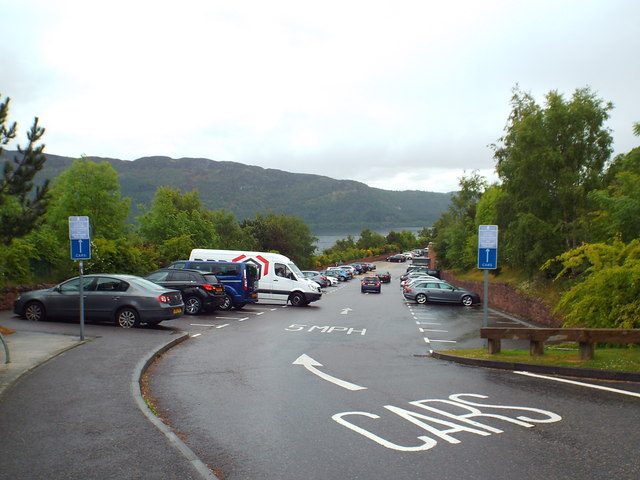
It is not private cars that fill it, or not only. Coach groups arrive too, all watching the same film and walking down the same path together.
Your fallback if it is full and you have not booked a space: drive on to Drumnadrochit, park at the Hub by the tourist office before the traffic lights, and walk back. That is about two miles each way on a road you would rather not push a buggy along. It works, but it is not what you had in mind.
First entry, or the last ninety minutes
On most days the site opens at 9.30am; the exceptions are 1 January, when it opens at 11am, and 25 and 26 December, when it is shut. Be at the barrier for 9.30 with your parking booked online, the only way to be sure of a space, and you have time to watch the film, walk down and climb the tower before the day gets going. That is the version of Urquhart worth the ticket.
The other window is the evening, and in high summer it is the better one. Between April and August last entry is 7.15pm and the gates do not close until 8.15pm. Arrive at six on a July evening and the light is long down the Great Glen. This does not fit the standard “arrive early” line, which is probably why nobody writes it.
Winter compresses everything: from November to March the site shuts around 4.30pm with last entry at 3.30pm. But there is nobody there. A wet Tuesday in January at Urquhart is one of the better hours you can spend in the Scottish Highlands if you have a decent coat, and our guide to Scotland in winter covers what else stays open around it.
Booking, and why it is effectively compulsory
Historic Environment Scotland sells timed tickets online below the door rate, and the parking space is a separate item added to the same basket. Between roughly May and September, treat both as required rather than advisable.
Two details people miss. Members go free, but booking ahead is still recommended to guarantee entry, and drivers should reserve parking online — free entry is not guaranteed access. And motorhome bays are sized for vehicles of roughly 4.5 to 6 metres and must be booked; if nothing shows online, the site genuinely cannot take you. Coaches have to book a space as well, and an organised group that arrives without one is not guaranteed entry either.
What is actually there, and what is not
Let me be straight about the fabric of the place, because plenty of writing about Urquhart implies a castle you walk through rooms in.
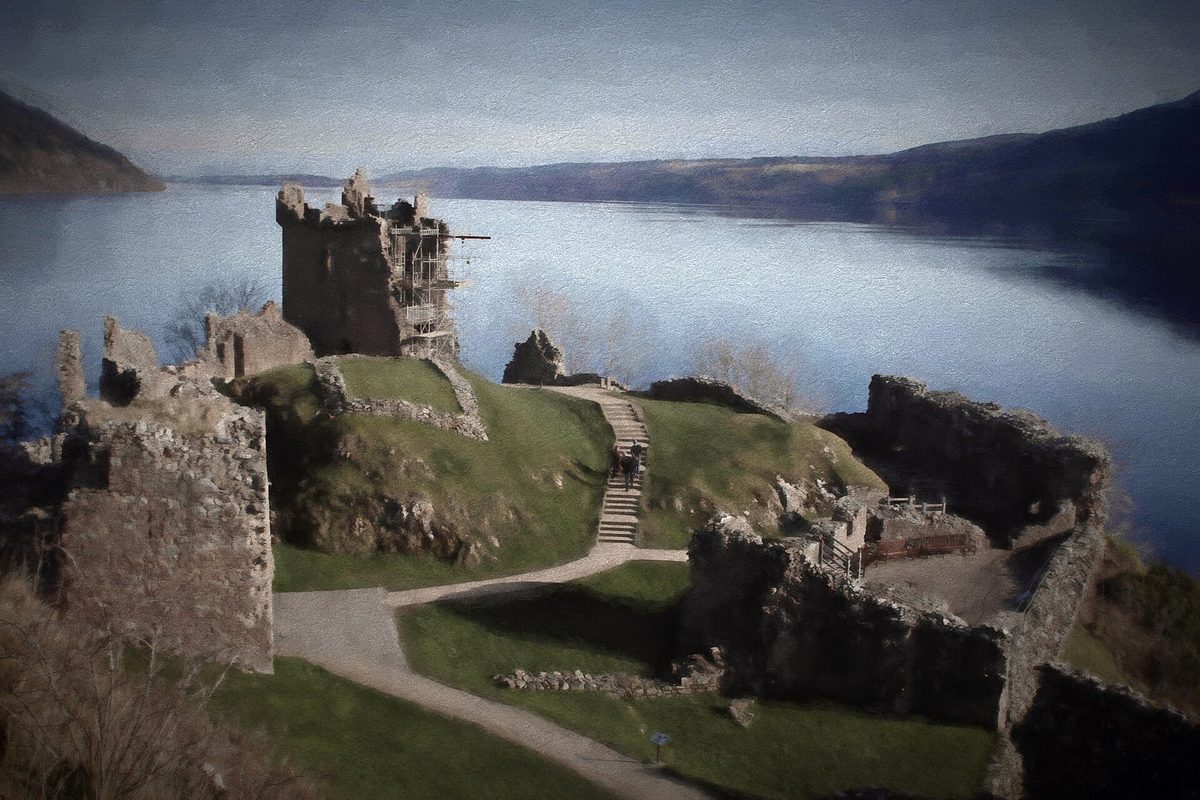
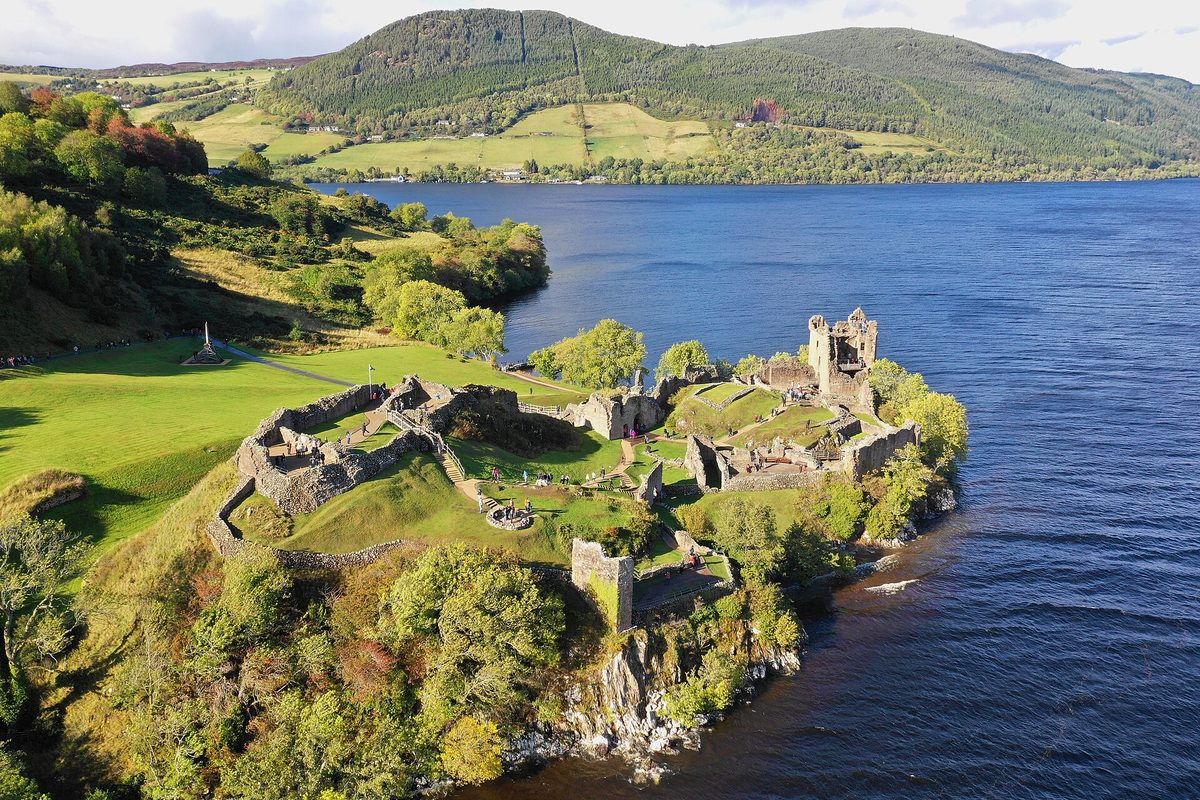
What survives is a long, narrow enclosure along a rocky promontory called Strone Point, water on three sides. Most of it stands knee to shoulder height: outlines of the great hall, the kitchen, the chambers, a dovecot at the far end. You read it as a plan rather than a building. There is one exception, and it is the reason the site works.
The Grant Tower
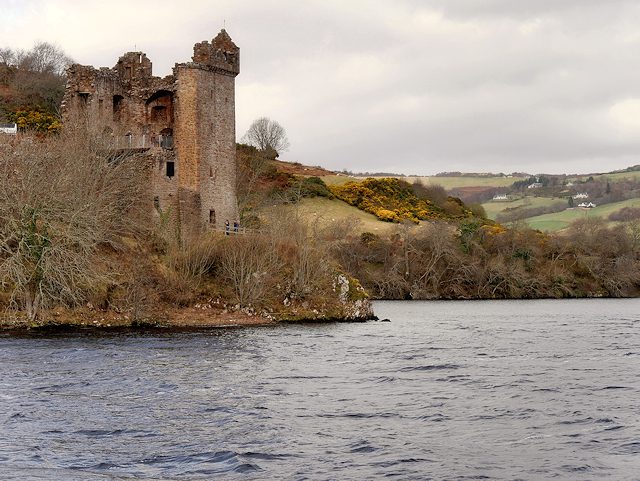
The Grant Tower is the tall block at the north end, five storeys, and the one to climb. Wooden stairs take you up inside the shell to a viewing platform, and the view from the top is what you came for whether you knew it or not: Loch Ness running away south-west between steep wooded shoulders, dead straight, because the loch sits in the Great Glen fault and the fault does not bend.
Part of the tower came down in a storm in 1715, which is why the south face is open like a doll’s house — stand in the gap and you can see floor lines and fireplace scars stacked up the wall. Give the top ten minutes rather than two.
The footings, and how to read them
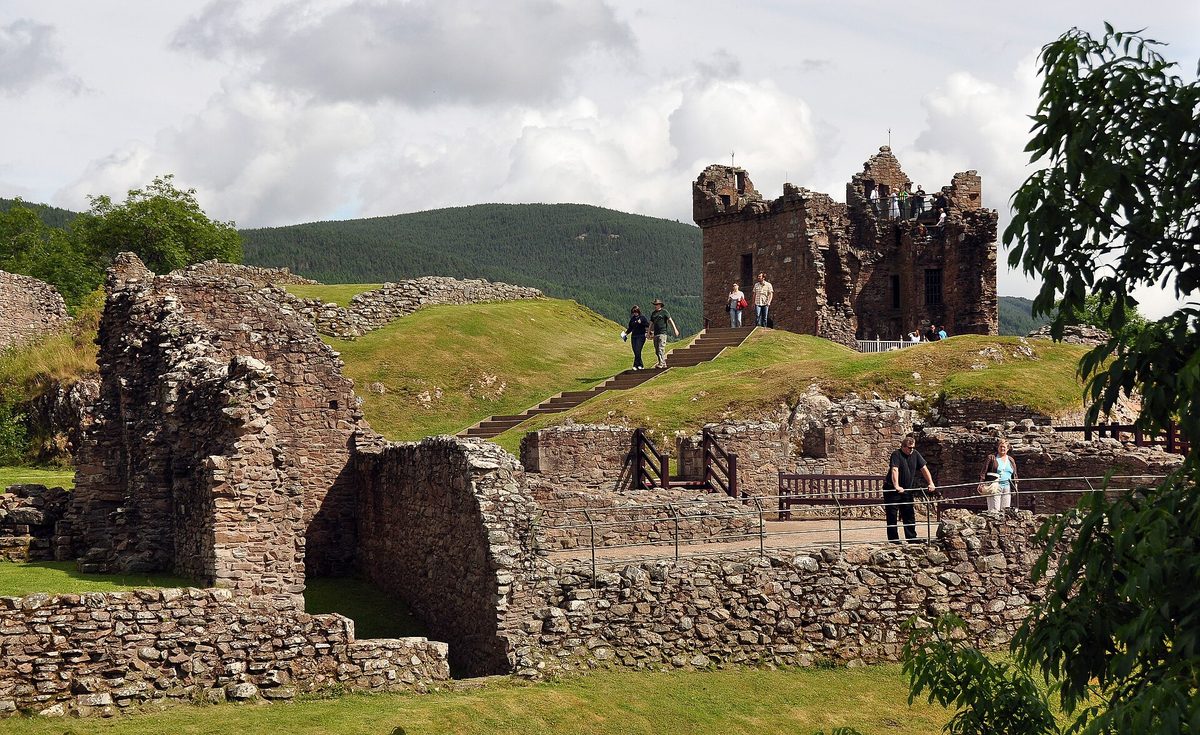
The rest rewards slowing down. The twin-towered gatehouse at the landward end retains enough to show how the entrance worked, with a ditch cut across the neck of the promontory in front of it. Below the great hall is a small dark chamber usually called the prison, said to have held the Gaelic bard Dòmhnall Donn. Down at the water there is a gate onto the loch reached by a steep flight of steps — worth doing, because it explains the castle. Supply and escape came by water, not road.
At the far south end, up a stepped path most people skip, sit the earthworks of the earliest castle and a ruined dovecot. Almost nobody goes up there, which is precisely why you should.
The trebuchet and the film
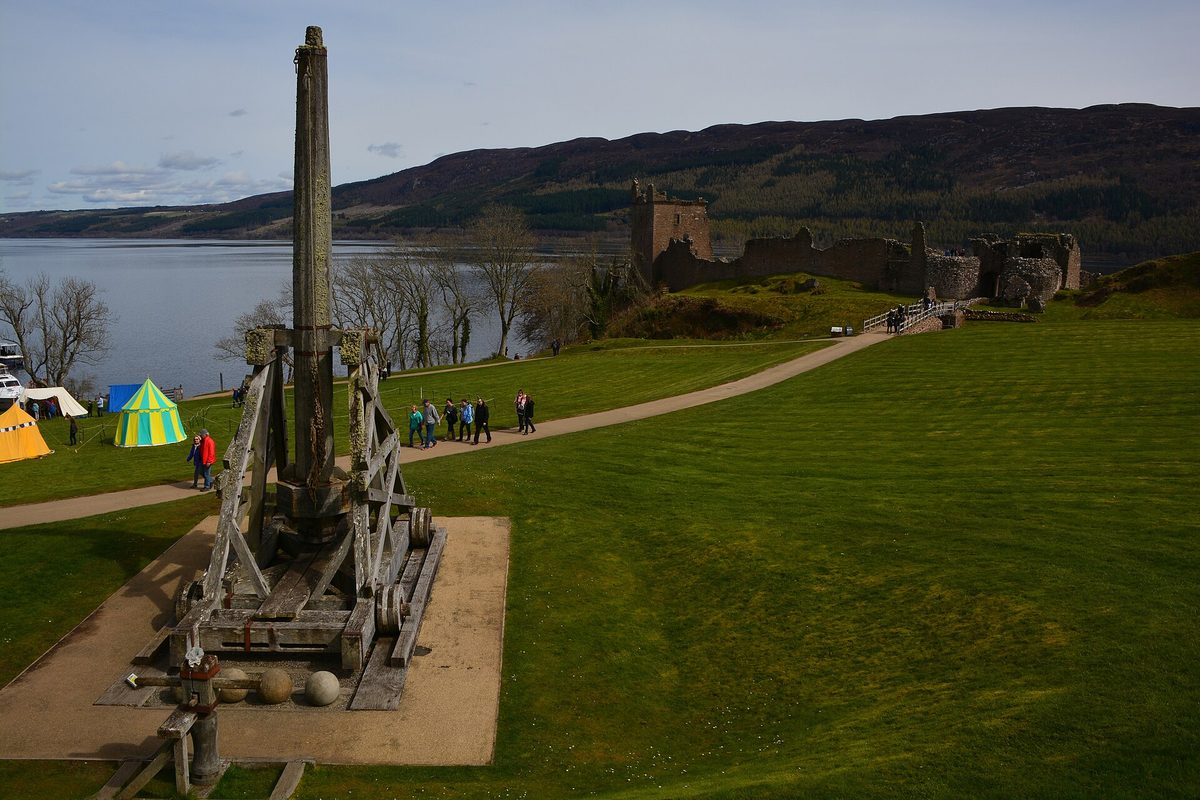
On the lawn between the visitor centre and the ruins stands a replica trebuchet, a timber counterweight siege engine. It frames the castle and the loch behind it beautifully from the path. Children stop dead in front of it. So do most adults.
The visitor centre runs a short film, around eight minutes, on a loop. I would normally tell you to skip an attraction film. Not this one. It is tight and well made, and at the end the screen lifts and the curtains draw back on a full-width window looking straight out at the castle and the loch. It is a proper theatrical moment and it lands.
So structure your arrival around it: go straight to the auditorium, catch the next showing, then walk down. Doing it the other way round wastes the reveal. Travelling with children, ask at the desk for the explorer quiz or the “castle of wolves” trail — find the blue wolf plaques, report your count at reception, collect a certificate. It buys a genuinely engaged forty minutes, and beats most of the alternatives in our guide to Scotland with kids.
A thousand years on one promontory
The history is unusually legible because the site kept being fought over for the same reason each time. Whoever held this rock held the middle of the Great Glen, and the Glen is the road between the west coast and the Moray Firth.
Before the castle
Something stood here long before the stone castle. Excavation has produced early medieval material including a fragment of Pictish brooch dated to roughly the late 700s or early 800s, which points to a high-status site rather than a farm. The story usually attached to it is Columba’s: travelling up the Glen to the court of Bridei, king of the Picts, he is said to have been called aside to a dying nobleman named Emchath at a place called Airdchartdan — the name that became Urquhart. Whether the fort meant is this exact rock is not provable, but it is a fair bet.
The medieval wars
The stone castle takes shape in the 1200s and immediately becomes a prize. Through the Wars of Independence it changes hands repeatedly between Scots and English garrisons. Then, for much of the 1400s, the trouble arrives from the west instead: the Lords of the Isles, the MacDonald sea-power based in the Hebrides, raided castle and glen again and again, running a lordship the Crown could not reliably control.
Urquhart stayed a royal castle until 1509, when it passed to Clan Grant — hence the tower. If you are chasing a family connection, our guide to tracing Scottish ancestry and clan tartans is a sensible starting point before you turn up expecting a plaque with your surname on it.
1692, and the long ruin
The end is deliberate, which is what makes it interesting. During the Jacobite risings of the late 1600s the castle was held as a garrison for government troops, and when those troops withdrew in 1692 they blew up key parts of it behind them, specifically so Jacobite forces could never use it as a base. The gatehouse took the worst of it.
Most Scottish castles decayed because nobody could afford the roof. This one was demolished on orders, by soldiers, as policy. Afterwards it was left to weather, the 1715 storm took the tower, and stone went off locally as it always did. By the Victorian era Urquhart had become what it is now: a picture, on the most photogenic promontory in the Highlands. If the Jacobite thread interests you, it runs through half the country — the Glenfinnan monument, further south-west, marks where the Jacobite standard was raised in 1745.
Tickets, prices and whether a pass pays
This is the site where the pass decision usually gets made, because for many people Urquhart is their second or third Historic Environment Scotland property and the maths suddenly matters.
What entry costs
An adult ticket is around £14 online and around £16 at the desk. Concessions (65 and over) are £11 online and £13 at the desk, children aged 7 to 15 £7 and £8, and under-7s go free. Family tickets exist. Prices move, so check before you travel — but booking online saves £2 per adult or concession and £1 per child, so two adults and two children are £6 up before they start.
Visitors with disabilities pay standard rates and no proof is required; up to two accompanying carers get in free per transaction. The audio guide runs on your own phone and is included, so arrive with a charged battery and ideally some data.
Explorer Pass or membership?
An adult Explorer Pass covers 14 consecutive days and costs £48 in summer (1 April to 31 October) or £38 in winter. Against a £14 Urquhart ticket, it only pays if the other sites on your list add up to more than the difference, so total the admissions you will actually use before you buy.
So if Urquhart is the only historic site on your trip, buy a single ticket. Add Stirling Castle and Fort George and you are at or past break-even. On a fortnight’s loop taking in Edinburgh Castle, Doune, Urquhart and a couple of abbeys, the pass is plainly cheaper. One caveat that catches people: Edinburgh Castle is by some distance the dearest site on the list, so a pass including it swings the maths much harder than one that does not.
Adult annual membership is £64 by annual Direct Debit or £72 by card, roughly four to five Urquhart-priced visits. If you live in the UK, or you are doing a long trip across several properties, it beats the pass and keeps working afterwards. Flying in for nine days to see three castles, it does not.
Say this plainly, because a lot of pages imply otherwise: neither buys priority entry here. They buy admission. You still book the slot, still book the parking, still walk down behind the same coach party. The pass saves money; timing saves the visit. If castles are the backbone of your trip, our overviews of Scotland’s castles and the ones worth routing around will narrow the list, and the region-by-region breakdown keeps the driving sensible.
Getting to Urquhart Castle
By car and by bus
From Inverness it is the A82 south-west along the shore, about 16 miles; allow extra time for getting stuck behind a motorhome, because you will. The entrance is signed on the left just past the castle and the turn comes up fast on a fast road, so slow early. From the south the same road climbs up from Fort William through Invergarry and Fort Augustus, one of the better hours of driving in the country. Our guide to getting around Scotland covers hire cars if single-carriageway Highland roads are new to you.
You do not need a car at all. The Scottish Citylink 919 between Inverness and Fort William runs along this stretch of the A82; check its timetable for the castle stop before you set out. The Stagecoach 17 reaches Drumnadrochit, about two miles north of the castle on foot. Check the return the night before — the last useful bus is earlier than you would like, especially outside summer. We have a car-free Scotland itinerary that includes this stretch.
By boat
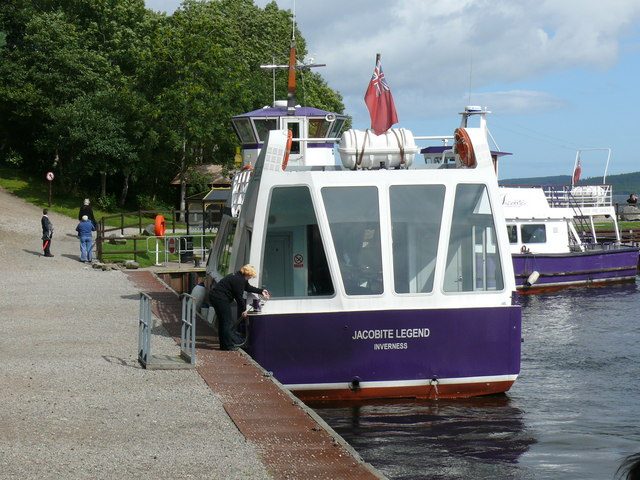
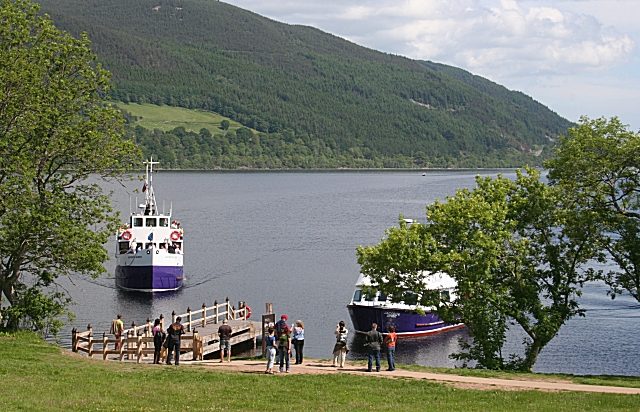
Arriving by water is the best version of getting here, and it is not a gimmick. The castle was built to be approached from the loch and it reads completely differently from a deck: the tower standing proud of the wooded hillside, the promontory finally making sense as a defensive position rather than a car park with a view.
Operators sail from Inverness, Dochgarroch, Clansman Harbour and Drumnadrochit, and they split into two types. Sightseeing-only cruises run down to the castle, turn in front of it and come back — you see it beautifully, you never set foot on it. Landing trips, such as Jacobite’s Freedom cruise, put you ashore at the jetty with admission included and give you about an hour at the castle before the boat collects you. Read the description carefully, because plenty of people book the first expecting the second. Our rundown of the best Loch Ness cruises sets out who does which. If you are sailing your own boat, jetty moorings must be reserved online like the parking.
The A82 layby question
People ask this constantly, so: yes, there is a pull-in on the A82 near the site that shows you the castle without paying, and no, it is not a substitute. What you get is a partial, distant, side-on view across the bay with trees in the way, from a patch of gravel usually full of cars doing exactly what you are doing. You cannot see the ruins from inside the car park either — there is a wall specifically to stop that.
The honest free options: walk in from Drumnadrochit for a glimpse through the foliage on the approach, or drive the quiet south-shore road for a long-lens view from across the water. A round-trip cruise gives the best view of all, though you are paying for the boat. If the real question is whether the castle justifies the money, the answer is the view straight down Loch Ness from the top of the Grant Tower, and that is what £14 online (£16 at the desk) buys.
Access, mobility and the steep path
This deserves more than the throwaway line it usually gets. The car park is level tarmac with accessible bays and the visitor centre is reached across it. From there the route is a steep tarmac ramp down through the building and then a steep tarmac path down to the ruins. Steep is the operative word, and everything you go down you come back up at the end, when you are tired.
Inside, paths are tarmac or bound gravel and mostly manageable. The Grant Tower is wooden stairs only, the water gate is down a steep flight of steps, and the early earthworks are up a stepped path. There are benches around the site, which matters more than it sounds. Historic Environment Scotland keeps two wheelchairs and two mobility scooters on site, first come, first served. On an August afternoon, do not count on one. If mobility is a real constraint, come in the first hour or see the castle from a boat instead.
Building a day around it
Ninety minutes at Urquhart leaves most of the day. Drumnadrochit, two miles up the road, is the practical hub — cafés, a pub, the Loch Ness Centre, and the car park you will need if you got the timing wrong. The exhibition is a solid hour and rather more scientific than its reputation suggests; it is largely about the survey expeditions rather than about believing in anything.
The best pairing in the area is a cruise and the castle, in either order. You see the promontory from the water and then stand on it, and Loch Ness is a long dark trench that is genuinely more impressive from a boat than from the shore road. Whether the loch justifies the detour at all is a fair question, and we have argued it both ways in is Loch Ness worth visiting.
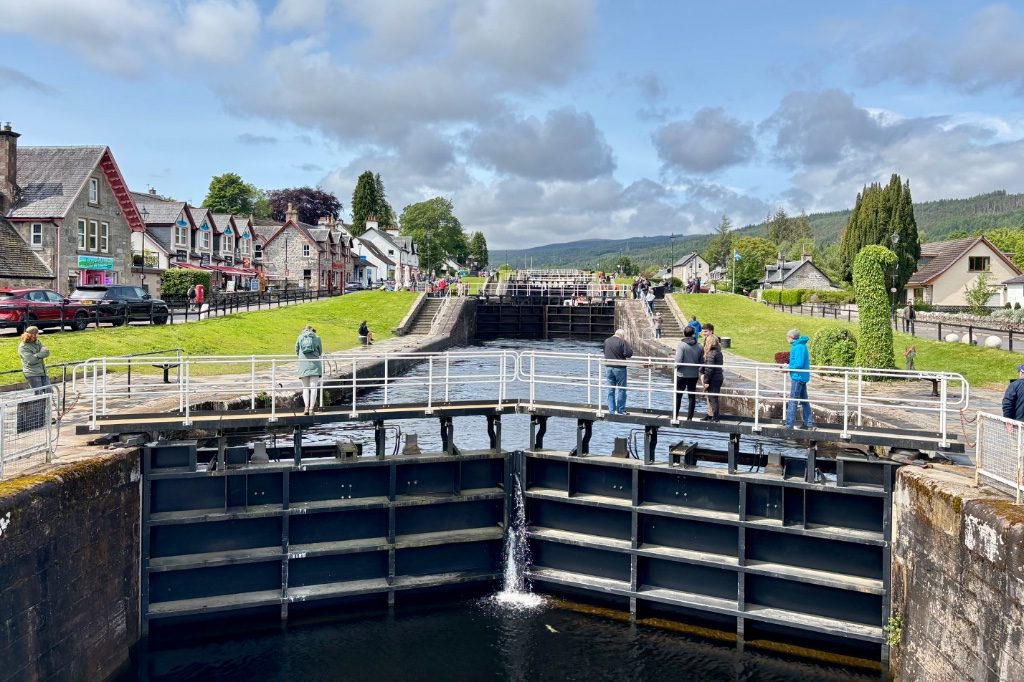
With an afternoon spare, keep going south-west rather than turning back to Inverness. Fort Augustus sits at the far end of the loch, about 20 miles on, with a flight of Caledonian Canal locks running through the middle of the village. Watching boats work up the staircase with a coffee is a better hour than it has any right to be.
As a base, Inverness gives you the most beds and buses; Drumnadrochit is quieter and puts you ten minutes from the gates, which is what you want if you intend to be first through them. Our guide to the Loch Ness and Inverness area goes into the trade-offs, and the best base towns in the Highlands helps if you are planning a wider loop. Urquhart also sits neatly on the run north towards the North Coast 500, or on the way up on an Edinburgh to Highlands road trip.
What underwhelms, and what to skip
Three hours is padding. Guides suggesting half a day are filling space. Ninety minutes covers the film, the walk down, the tower, the footings, the water gate and the trebuchet at an unhurried pace. Two hours with lunch.
The exhibition is fine, not great. Real artefacts, including the Urquhart Ewer, and a model of the castle as it stood. A pleasant ten minutes. If the room is three deep in coach passengers, walk past and come back on the way out.
Do not come for the monster. There is essentially no Nessie content at the castle. That is Drumnadrochit’s department.
Do not come in the rain if you can avoid it. Almost nothing here is under cover. The visitor centre and café are; the castle is not, and there is nowhere to shelter beyond the tower stairwell. A wet visit is a short visit.
The café is competent, not a destination. Soup, sandwiches, cakes, decent coffee, an outdoor terrace with a good view. For a proper lunch, eat in Drumnadrochit.
It is not a substitute for a complete castle. If you want rooms, furniture and painted ceilings, Urquhart will disappoint you and Culzean will not. If you want a ruin in a landscape, this and Dunnottar are the two best in the country, and they are nothing like each other.
Frequently asked questions
How long do you need at Urquhart Castle?
Ninety minutes is plenty for a thorough visit: the film, the walk down, ten minutes on the tower, a circuit of the footings and the water gate, and the trebuchet. Stretch to two hours if you plan to eat at the café. Anything longer and you will be waiting for someone.
Do you need to book Urquhart Castle tickets in advance?
In summer, yes — and book the parking space too, since it is a separate item and the barrier turns away cars without one. Winter visits can usually be walked up, though online is still a couple of pounds cheaper. Members and pass holders also need to reserve a slot.
What is the best time of day to visit Urquhart Castle?
First entry at 9.30am, or the final ninety minutes before last entry. Parking fills up in summer, so book a space online. From April to August the gates stay open until 8.15pm, which makes a six o’clock arrival quiet and beautifully lit.
Can you see Urquhart Castle for free?
Only partly. A pull-in on the A82 gives a distant, angled view, and there is a glimpse through the trees on the walk in from Drumnadrochit. The car park itself is walled off. None of it replaces standing on the Grant Tower, which is the whole point of coming.
Is Urquhart Castle wheelchair accessible?
Partially. Car park and visitor centre are level and accessible, but reaching the ruins means a steep ramp then a steep path, uphill on the way back. Inside, surfaces are tarmac or bound gravel; the tower is stairs only. A couple of wheelchairs and mobility scooters are kept on site, first come first served.
Is the Historic Scotland Explorer Pass worth buying?
Only as part of a wider trip. The adult pass is £48 in summer or £38 in winter, while Urquhart alone is £14 online, so whether it saves you anything depends on which other sites you visit. For one visit, buy the single ticket. Returning within a year, annual membership at £64 by Direct Debit (£72 by card) wins.
Can you get to Urquhart Castle without a car?
Easily. The Citylink 919 from Inverness runs along this stretch of the A82, so check its timetable for the castle stop, and Stagecoach services reach Drumnadrochit two miles away. Several cruise operators run landing trips with admission included, and guided coach tours from Inverness bundle transport, boat and ticket together.
Is Urquhart Castle better than Eilean Donan?
They do different jobs. Eilean Donan is restored, roofed and furnished, and you walk through rooms. Urquhart is a true ruin with a far better outlook. Want interiors, choose Eilean Donan. Want setting and atmosphere, Urquhart takes it comfortably.
Final thoughts
Urquhart is not a great building. It is a great position with one great tower on it, and a state-sanctioned demolition in its past explaining why there is not more. The site itself will hold your genuine interest for about forty-five minutes.
What decides whether you love it or shrug is almost entirely when you show up. Book a slot, take the first entry or the last of the evening, watch the film and let the screen lift, walk down before the coaches, and give the top of that tower ten unhurried minutes looking down the Great Glen. Do that and you will remember it for years. Get it wrong and you will remember a queue. It is October as I write, which is a good month for exactly this — short hours, low light, hardly anyone about, as our guide to Scotland in October explains.
About the author: This guide was written and is maintained by the ScotlandTourism.org editorial team — travel writers who’ve spent years exploring Scotland’s cities, Highlands and islands, from bagging Munros to chasing the perfect dram. We update our guides regularly to keep prices, opening details and advice current.
Last updated: October 2026. Prices and opening times change — always check the official site before you travel.
Photo credits
All images are used under their respective Creative Commons or public-domain licenses:
- Urquhart Castle from the air, on its promontory jutting into Loch Ness — Mingkai Zhang, CC BY-SA 4.0, via Wikimedia Commons
- The car park at Urquhart Castle, which fills solid from late morning through the summer — Malc McDonald, CC BY-SA 2.0, via Wikimedia Commons
- Urquhart Castle from the path down from the visitor centre, looking north-east up Loch… — BIG ALBERT, CC0, via Wikimedia Commons
- Footings and low walls of the domestic ranges at Urquhart Castle, with the Grant Tower… — Nilfanion, CC BY-SA 3.0, via Wikimedia Commons
- The Grant Tower at Urquhart Castle seen from the water of Loch Ness — David Dixon, CC BY-SA 2.0, via Wikimedia Commons
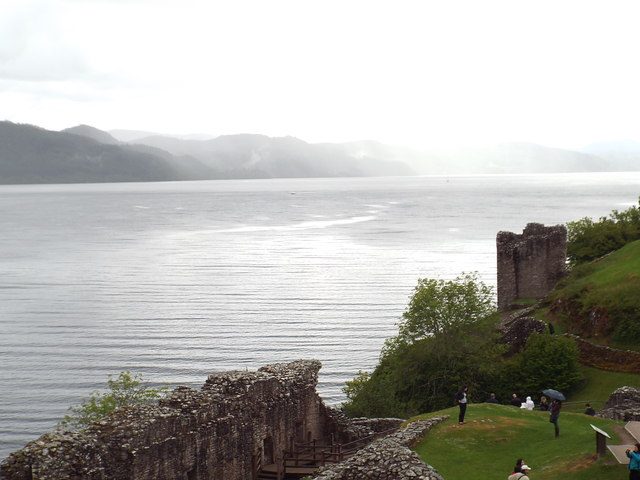
- The view down Loch Ness from inside Urquhart Castle on a grey day — Malc McDonald, CC BY-SA 2.0, via Wikimedia Commons
- The full-size trebuchet on the lawn above Urquhart Castle — Lewis Clarke, CC BY-SA 2.0, via Wikimedia Commons
- A Loch Ness cruise boat at its jetty near Inverness — Susannah Muldoon, CC BY-SA 2.0, via Wikimedia Commons
- The Caledonian Canal lock flight at Fort Augustus, at the southern end of Loch Ness — David Dixon, CC BY-SA 2.0, via Wikimedia Commons