The first time I drove out to the Glenfinnan Viaduct I got it comprehensively wrong. I arrived at about half past ten on a Tuesday in July, found the car park full, spent twenty minutes circling, eventually squeezed in somewhere I probably shouldn’t have, and jogged up the hill. I reached the top just in time to watch a plume of white smoke vanishing behind a shoulder of hillside. The whole event had lasted around two minutes and I had missed every one of them.
That is the honest problem with this place. Every guide tells you to arrive early. Almost none of them tells you what early means, which car park, which path, how long the walk actually takes, or that an ordinary diesel train crosses those same arches several times a day for the price of a sandwich. This is the operational version. Get the timings right and it is one of the best hours you will spend in the Scottish Highlands. Get them wrong and you have written off a day.
The short answer
The Jacobite steam train, operated by West Coast Railways, runs Fort William to Mallaig and back through the summer, crossing the Glenfinnan Viaduct up to four times a day. Park at the National Trust for Scotland visitor centre (£5), walk 20–25 minutes uphill to the elevated viewpoint, and be in position at least 30 minutes before the crossing.
Glenfinnan at a glance
| Option | What you actually get | Time needed | Cost |
|---|---|---|---|
| NTS visitor centre car park area | A distant, level, wide view of the whole viaduct | 20–30 minutes | £5 car park (free for members) |
| Upper trackside viewpoint (west side) | The classic elevated photograph, train coming towards you | 60–75 minutes including the walk | Free once you’ve parked |
| Lower trail under the arches | Scale and engineering, but no train shot worth having | 40–50 minutes | Free once you’ve parked |
| Riding the Jacobite | A superb day out — and almost no view of the viaduct itself | Most of a day — about 5 hours 45 on the morning run | From around £76 adult return in standard |
| Ordinary ScotRail service over the viaduct | The same crossing, no steam, pocket-money fare | About 35 minutes each way from Fort William | From around £4.70 each way to Glenfinnan |
| Glenfinnan Station Museum | Shelter, context, a dining-car cafe and a signal box | 45 minutes | £1 minimum donation, children free |
| Glenfinnan Monument climb | A tight spiral stair and a Loch Shiel panorama | 30 minutes | £5 adult, £4 child |
| Loch Shiel shore and lower glen | The quiet half of Glenfinnan, ignored by almost everyone | 45 minutes | Free |
The timetable is the only thing that matters
Understand this and everything else falls into place. You are not planning a visit to a viaduct. You are planning a day around a single two-minute window, and that window is set by a heritage railway operator in Lancashire, not by you.
The Jacobite is run by West Coast Railways, who have held the operating licence for this service since 1995. It runs from Fort William to Mallaig and back along the Mallaig Extension of the West Highland Line, a round trip of about 84 miles. It is not a scheduled public service. It is a charter, it runs seasonally, and it has been suspended more than once in recent years.
The 2026 season, in plain terms
For 2026 the morning service runs seven days a week from Monday 1 June to Friday 23 October. The afternoon service runs seven days a week from Wednesday 10 June to Friday 25 September. Those dates are unusual and worth knowing about: the season normally opens in early April, and this year it did not.
The reason is a long-running argument with the Office of Rail and Road about central door locking on the operator’s heritage Mark 1 carriages. In 2025 the train ran with more modern Mark 2 stock, which passengers disliked and which cost more to operate. West Coast Railways has since agreed to fit central locking across its mainline Mark 1 fleet, and the 2026 season was delayed while a timeline was settled. If you take one thing from this section, take this: check the operator’s own timetable page before you commit to a date, because this service is genuinely less certain than a ferry or a scheduled train.
Departure times, and when the train is actually on the bridge
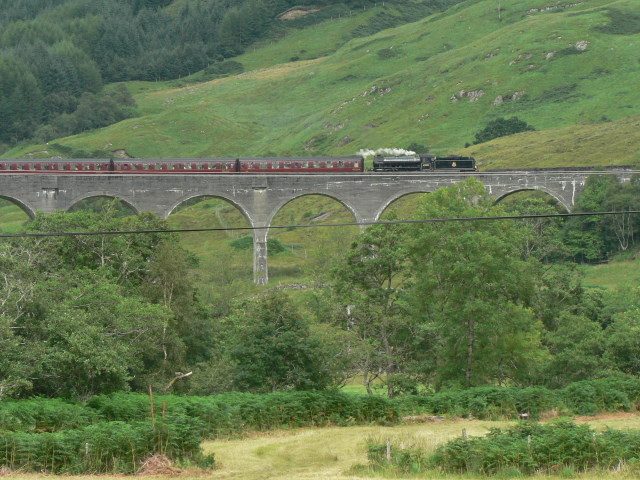
The published 2026 times are straightforward. The morning train leaves Fort William at 10:15 and reaches Mallaig at 12:25, then leaves Mallaig at 14:10 and gets back to Fort William at 16:03. The afternoon train leaves Fort William at 12:50, arrives Mallaig 15:06, departs Mallaig 17:00 and returns at 18:52.
Those are the times you can book. What you need are the times the train is on the viaduct, which nobody publishes officially. Glenfinnan Station Museum, a mile from the arches and rather well placed to know, says the train usually crosses at about 10:50 in the morning and about 15:15 in the afternoon. Working from the departure times, westbound crossings land roughly 35–45 minutes after leaving Fort William, and eastbound crossings roughly 50–60 minutes after leaving Mallaig.
So on a day when both services run, you get four chances: around 10:50 and around 13:30 heading west, and around 15:15 and around 18:00 heading east. Treat all four as approximate. Steam trains lose time, and when I finally saw it properly it was twelve minutes late. The exact expected crossing times for the day are chalked up inside the National Trust visitor centre, and that board is the most reliable thing in Glenfinnan. Read it before you walk anywhere.
Which crossing to aim for
Go for a westbound one, Fort William to Mallaig. From the classic viewpoint the train comes towards you and the locomotive is leading, which is the composition you have seen a thousand times. On the return leg the engine runs round at Mallaig and comes back the other way, so from the west-side viewpoint you spend the whole two minutes photographing a train going away from you. If the eastbound run is all you can make, walk up the other hill instead — turn right rather than left at the foot of the arches, for the east viewpoint, and the train comes towards you again.
Of the two westbound crossings, the morning one at around 10:50 is by some distance the busier. The 13:30 one is noticeably quieter, because the coach parties and the early risers have moved on and a lot of people never realise there is a second westbound run at all. If you are travelling in autumn, the light on this hillside in October is lovely and the crowds are a fraction of what they are in July.
Four ways to see the viaduct, and what each one costs you
There are really only four options, and people routinely choose the wrong one.
Option A: ride the train, and see almost nothing
This is the great irony of Glenfinnan. Buy a ticket on the Jacobite and you will have a genuinely fine day out — the run along Loch Eil, the sea coming into view past Lochailort, the white sand at Morar — but you will barely see the viaduct, because you are on it. You get Loch Shiel out of the left-hand windows and a glimpse along the curve if you are quick and sitting on the correct side. That is it. Do not pay £76 expecting the postcard.
Option B: the visitor centre and the hill behind it
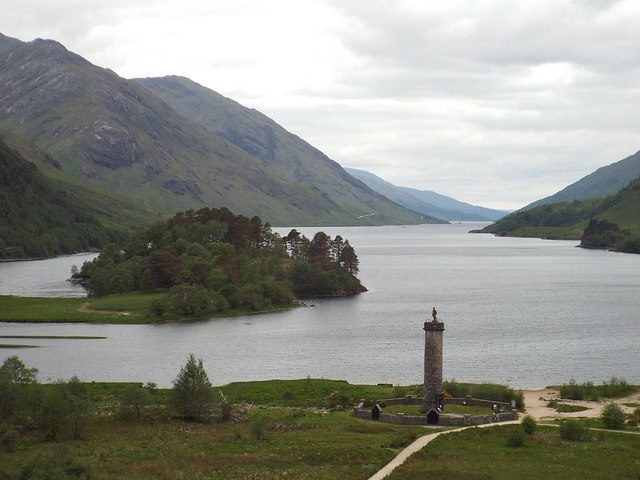
The easy option. From the National Trust car park you can see the full sweep of the viaduct across the glen without walking anywhere in particular, and a five to ten minute climb up the small hill behind the visitor centre gives you the whole structure with Loch Shiel and the monument in the same frame. It is distant. Your phone will not do it justice. But it is level enough for most people, it is close to the toilets and the cafe, and if you have small children or limited mobility it is the sensible choice. It is also, in my opinion, the better landscape photograph, even if it is a worse train photograph.
Option C: the upper trackside viewpoint
This is where every image you have ever seen of this place comes from. From the car park, follow the signed Viaduct Trail along the River Finnan towards the arches. At the foot of the viaduct a slate sign points left and uphill. Climb.
Allow 20–25 minutes from car to viewpoint, not the ten minutes some guides quote, because in season you will be queueing behind people on a narrow path and the last section is steep, eroded and often slick. The higher you go, the better the angle on the curve and the fewer heads you get in the frame. Boots or trainers with grip, not sandals. There is no shelter, no water and no toilet up there, and you may well be standing about for 45 minutes.
One firm instruction: do not walk on the viaduct or the track. It is a criminal offence under railway byelaws, British Transport Police have issued public warnings after near misses with trains here, and the line is single track with no refuge. People still do it. Do not be one of them.
Option D: the lower trail, under the arches
The path continues underneath the viaduct and along the glen, and standing directly beneath 100 feet of curving concrete is genuinely impressive in a way the long view is not. You get a sense of the sheer bulk of the piers, the streaking and staining of 125 years of west-coast weather, and the strange smoothness of mass concrete poured into timber shuttering. It is also almost empty ten minutes after a train has passed. As a train-watching spot it is useless — you see wheels and steam and nothing else — but as a walk it is the best twenty minutes in Glenfinnan.
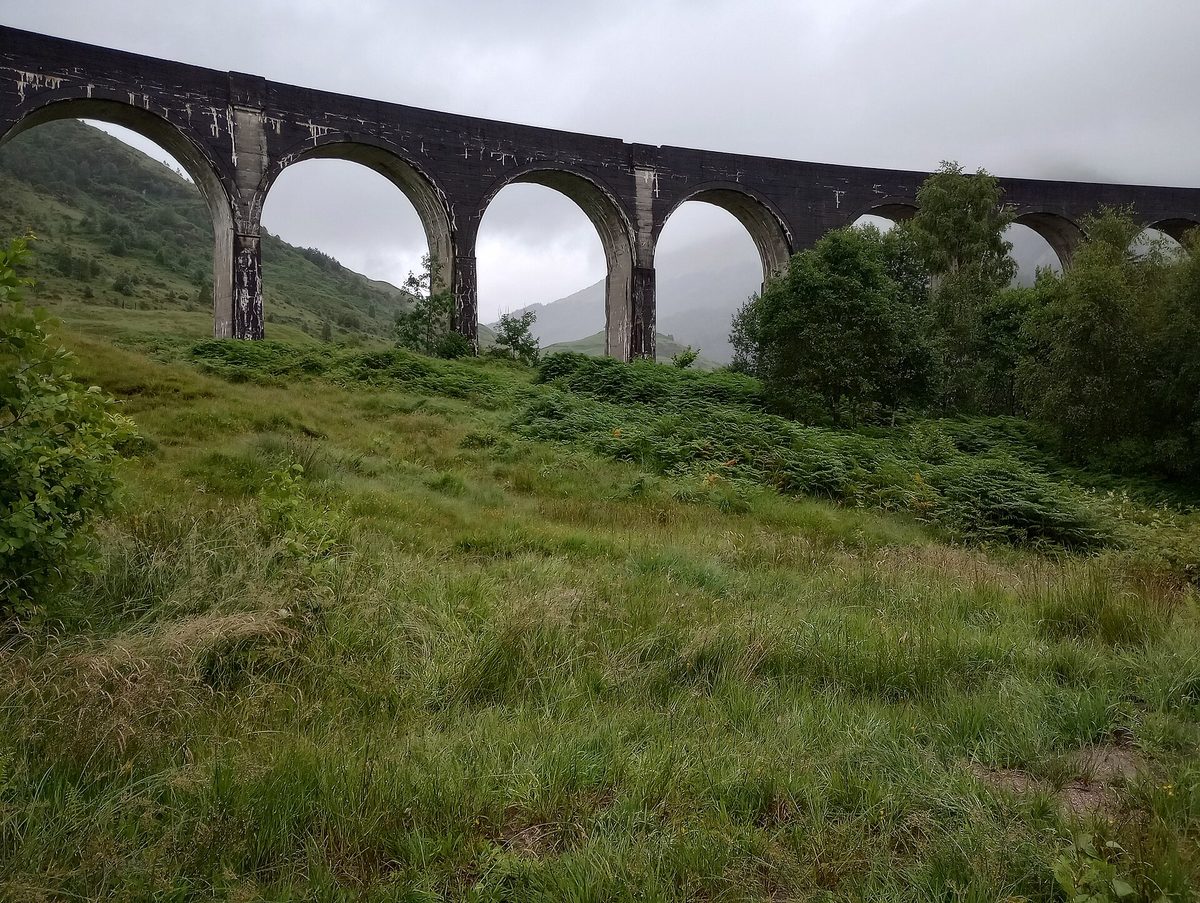
The car park problem, stated bluntly
This is the part that ruins trips, so I will be direct about it.
What exists
There are two visitor car parks. The National Trust for Scotland car park at the visitor centre costs £5 at the time of writing and is free to Trust members. It is small, and it cannot take motorhomes. Next door is the Glenfinnan community car park, linked to the Trust site by a pedestrian bridge, which does have larger vehicle bays. There is also a small car park at the bottom of the station approach belonging to Glenfinnan Station Museum, which asks for a donation. The car park at the top of the station approach is for ScotRail staff, rail passengers and blue badge holders only.
That is the entire supply. For a site that draws hundreds of thousands of people a year to a hamlet on a single-carriageway road, it is nowhere near enough, and everyone locally knows it.
What actually happens on a July morning
Both car parks start filling roughly 60 to 90 minutes before a crossing. By around 09:45 on a fine mid-July day you are gambling. The Trust’s own advice, published on its website, is that if both car parks are full you should try again later or come back another day — which tells you everything about how bad it gets.
My rule for high summer is to be parked by 09:30 for the 10:50 crossing, and by 12:15 for the 13:30 one. That feels absurdly early. It is not. It buys you a space, a coffee, a look at the crossing-times board and an unhurried walk uphill, and the difference between that and my first visit is the difference between a good morning and a wasted one.
Do not park on the verge
The A830 through Glenfinnan is not wide. Parking on verges, pavements, driveways, double yellow lines or in passing places is illegal, it blocks the road for buses and delivery lorries and, more seriously, for ambulances. The Trust states plainly that traffic police monitor the area and that vehicles parked illegally may be towed away. This is not a soft warning. Locals have watched their village gridlock over this for years, and enforcement has tightened accordingly.
Two more practical notes. The only public toilets in Glenfinnan are at the Trust visitor centre; when it closes there is an out-of-hours block in the car park that costs £1 to open and does not respond to a radar key. After that, the nearest are at Corpach, 13 miles east, or Arisaig, 19 miles west. And there is no shop or supermarket — the nearest are in Fort William or Mallaig. Bring water. This is a good general principle for a first trip to Scotland: assume the next facilities are 30 minutes away, because they usually are.
The cheap workaround almost nobody mentions
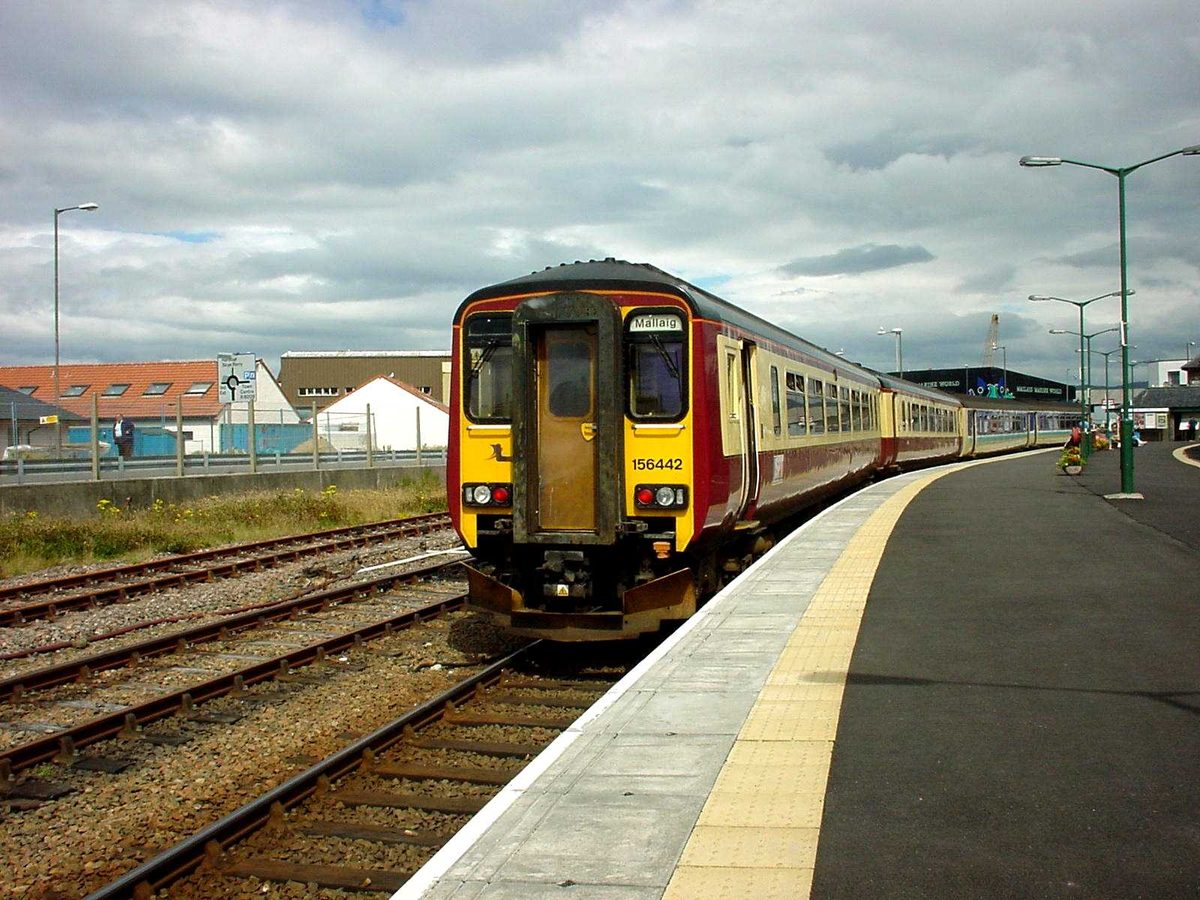
Here is the thing that changes how you plan this. The Jacobite is not the only train that crosses the Glenfinnan Viaduct. ScotRail runs an ordinary scheduled service over it, roughly four times a day each way to Mallaig, all year round, and you can be on it for a few pounds.
Crossing the viaduct for the price of a bus fare
Fort William to Glenfinnan takes about 35 minutes and costs from around £4.70 each way as part of a return at the time of writing. Fort William to Mallaig, the full run, starts from about £9.50 each way. There is no booking fee, tickets go on sale twelve weeks ahead, and you buy from the guard at Glenfinnan because there is no ticket office. It is the same track, the same 21 arches and the same view down Loch Shiel that people are paying £76 for. What you don’t get is steam, a heritage carriage and the theatre of it — which is a real difference, but it is not a £70 difference for everyone.
Better still, going by rail solves the car park entirely. Trains from Fort William cross the viaduct and then stop at Glenfinnan station, about a kilometre west of the arches. You step off, walk two kilometres back along the hillside path to the viaduct, or a kilometre along the pavement to the visitor centre, and you have arrived without competing for a bay. If you are building a trip around the railways anyway, this slots neatly into the wider network of Scotland’s scenic rail journeys, and it is the single strongest argument for seeing Scotland without a car.
What is waiting at the station
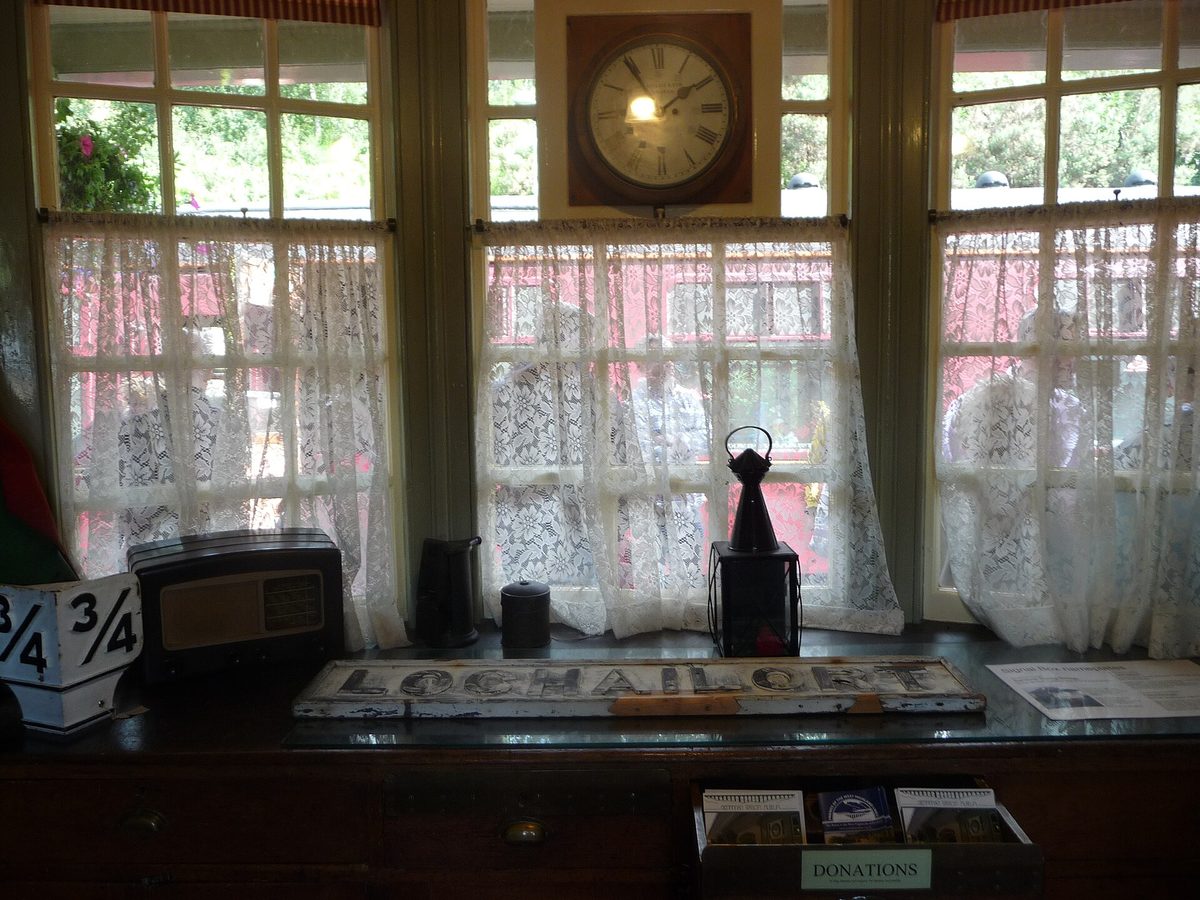
Glenfinnan station itself is worth the trip on its own, and it is a fraction as busy as the viewpoint. The chalet-style building dates from 1901, designed by James Miller and built in mass concrete by the same contractor as the viaduct. Since 1991 it has housed the Glenfinnan Station Museum, which covers the building of the Mallaig Extension and life on the line. Admission is a £1 minimum donation for adults and free for children, and there is an interactive former signal box.
Alongside it, in a converted railway carriage, is the Dining Car cafe — soup, sandwiches, cake, a proper roof over your head when the weather turns, which it will. Opening is seasonal and broadly Tuesday to Saturday during the season; the museum itself opens for the season on 1 April and runs to the end of October, 9am to 5pm Monday to Saturday and 10am to 5pm on Sundays. The museum also does luggage storage for around £5, which is quietly brilliant if you are travelling between places by train.
There is also a converted 1958 sleeping car on site that has operated for years as bunkhouse accommodation. Note that this has changed: for the 2026 season the previous leaseholders have stopped running it, and the museum has said the sleeping car is now available to members of the Friends of Glenfinnan Station and other volunteers rather than to the general public. If you had it in mind as a place to stay, email the museum first rather than assuming.
Coming by bus, and the rewards for doing it
Shiel Buses run a service along the A830 between Fort William and Mallaig, stopping both at the visitor centre and at the railway station. It is not frequent, so you are planning around it rather than with it, but it works.
The National Trust actively rewards arriving without a car. Show a valid bus or train ticket at the visitor centre and you get a free hot drink; there is also two-for-one on the monument climb, free entry to the Station Museum, a discount on Loch Shiel Cruises and a drink at the Glenfinnan House Hotel with a food purchase. Given that a car park space costs £5 and a great deal of stress, that is not a token gesture. If you are working out how to move around the region generally, our guide to getting around Scotland goes into the bus and rail combinations in more detail.
Riding the Jacobite: what you actually get
If you do want to ride it — and it is a lovely thing to do once — here is the current picture.
Fares and booking
At the time of writing the 2026 fares are £76 adult and £43 child for a standard day return, and £116 adult and £76 child in first class, with a private table for two at £252. There is a minimum booking fee of £3.75 and a £15 admin fee if you amend a booking. First class requires a minimum of two passengers; solo travellers go standard. Everything is a same-day return on the same train — there are no one-way tickets, which catches out people hoping to ride out and drive back.
Tickets for the following season typically go on sale over the winter, and July and August sell out weeks or months ahead. First class goes first, because there is far less of it. Sign up to the operator’s mailing list rather than checking the site hopefully in May. The guard may hold a handful of seats for sale on the day at Fort William station, cash only, first come first served — never build a plan on that.
The engine, and what may be on the front
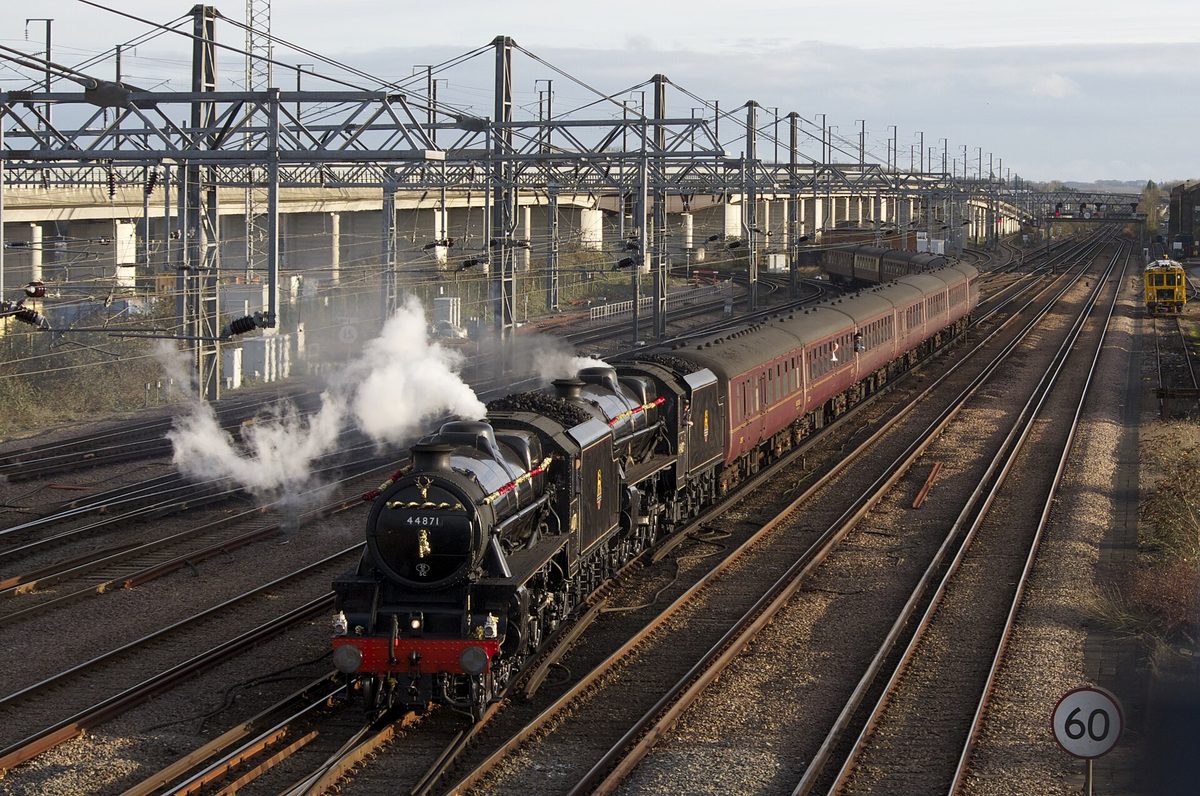
The locomotives are usually LMS Stanier Class 5s, the “Black Fives” — 45407 The Lancashire Fusilier has worked this train for years, with 44871 and 45212 also in the frame — or occasionally the Peppercorn K1, 62005 Lord of the Isles. The operator reserves the right to use a heritage diesel in cases of high fire risk or mechanical failure, with no refund, which is worth knowing before you book a trip around it in a dry August.
On board, and the ninety minutes in Mallaig
Sit on the left going out for Loch Eil, Loch Shiel and the curve at Glenfinnan. Carriages are heritage stock, which means character rather than comfort; the windows between carriages open wider than the ones at your seat and are where the photographs happen. When the timetable allows, the train slows on the viaduct crossing, and there is often a pause at Glenfinnan station long enough to stretch your legs and look in at the museum.
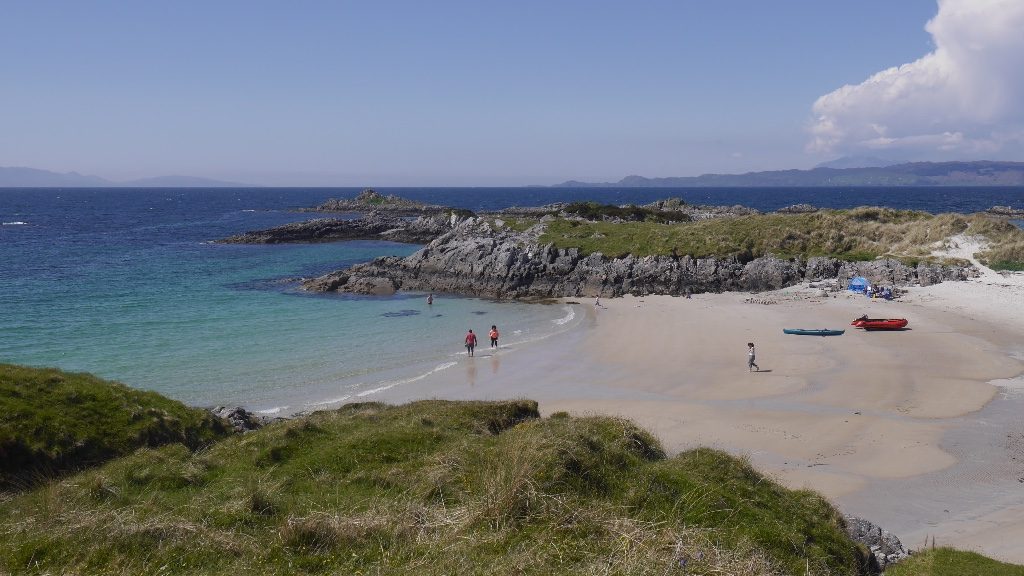
At Mallaig you have about ninety minutes while the engine runs round. It is a working fishing port with ferries out to Skye, the Small Isles and Knoydart, and the seafood is excellent, but ninety minutes goes fast — book a table if you want to sit down. If you would rather build a longer trip out of this, Mallaig is the mainland gateway to the Isle of Skye by ferry, and the beaches you pass on the way at Morar and Camusdarach are among the finest in the country.
The Harry Potter connection, told accurately
Let us get the details right, because a lot of what circulates is wrong.
The viaduct appears across several of the films. The best-known sequences are the flying Ford Anglia chasing the Hogwarts Express in Chamber of Secrets (2002) and the Dementors boarding the train in Prisoner of Azkaban (2004), with further appearances in Goblet of Fire and Half-Blood Prince. The company that runs the Jacobite supplied Warner Bros. with the train used as the Hogwarts Express and access to the route.
But the locomotive you will see on the viaduct is not the one from the films. The screen engine was GWR 4900 Class 5972 Olton Hall, painted in that unmistakable crimson, and it now sits at the Warner Bros. Studio Tour in London rather than in the Highlands. What crosses Glenfinnan today is a Black Five or a K1 in black, hauling maroon carriages. Similar enough for the photograph. Not the same engine. If your trip is built around the films, our guide to Harry Potter locations across Scotland maps out what is real, what is a set and what is a stretch, and the Edinburgh side of the story is a good half-day in its own right.
The Glenfinnan that has nothing to do with wizards
Strip away the films and this is still one of the more remarkable pieces of Victorian engineering in Britain, in a glen that carries a great deal of Scottish history.
Concrete Bob’s viaduct
The Mallaig Extension needed a crossing of the River Finnan, and the local schist was brutally hard to work. The contractor Robert McAlpine & Sons, headed by the man the trade nicknamed “Concrete Bob” for his faith in the material, poured the whole thing in mass concrete instead — no steel reinforcement at all, just concrete strong in compression and shuttered into shape. Simpson & Wilson were the engineers. McAlpine’s son Robert, then 28, ran the job, with his younger brother Malcolm as his assistant.
The numbers: 21 semicircular spans of 50 feet, 380 metres long, 100 feet above the river, built on a curve, carrying a single track between parapets 18 feet apart. Work started in 1897, the structure was complete enough by October 1898 to carry materials across the valley, and the line opened on 1 April 1901. It cost £18,904. It is the longest concrete railway bridge in Scotland, it is a Category A listed structure, and Network Rail carried out a major programme of repairs on it from 2024. It also appears on the Bank of Scotland £10 note, which is a nicely Scottish sort of fame.
The horse in the pier
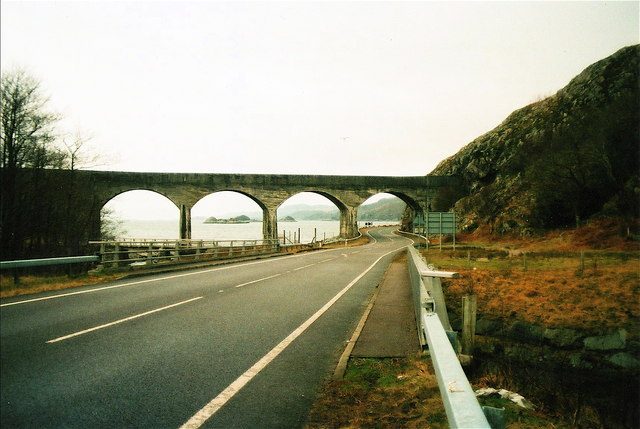
The best story about the viaduct is one that turned out to be about a different viaduct entirely. For most of a century, locals maintained that a horse and cart had fallen into one of the piers during construction and been entombed in the concrete. In 1987 Professor Roland Paxton lowered a borescope down boreholes into the only two Glenfinnan piers large enough to hold a horse, and found nothing. Acting on local hearsay, he tried the Loch nan Uamh viaduct further west in 1997, and found rubble. Then in 2001, using scanning equipment, the remains of a horse and cart were finally located inside the large central pylon at Loch nan Uamh. The legend was true. It had simply been attached to the wrong bridge for a hundred years.
You drive under Loch nan Uamh viaduct on the A830 on the way to Arisaig. It is a two-minute stop and hardly anyone bothers.
19 August 1745
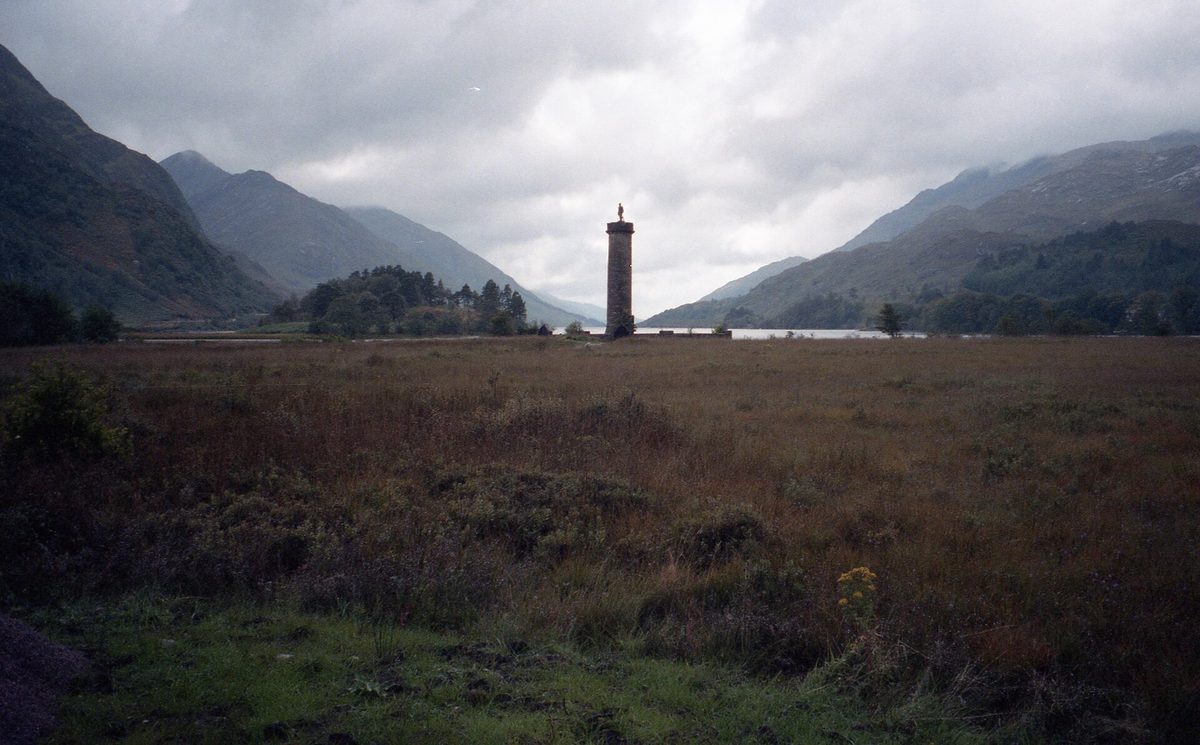
Down at the loch shore stands the Glenfinnan Monument, an 18-metre tower put up in 1815 with a lone Highlander on top. It marks the spot where Prince Charles Edward Stuart raised his standard on 19 August 1745 and around 1,200 Highlanders pledged themselves to the Jacobite cause, eight months before it ended at Culloden. The visitor centre exhibition tells that story properly, in English and Gaelic, and it is free to walk in.
You can climb the monument for around £5 at the time of writing (£4 for children and concessions, £13 for a family), currently opening 11:00–12:30 and 13:30–16:00. It is a narrow, dark spiral stair with a small platform at the top and it is not for anyone uneasy about heights or tight spaces. The view down Loch Shiel from up there is the reason to do it. Under-18s must be accompanied by an adult.
Planning the day around it
Glenfinnan sits 18 and a half miles west of Fort William on the A830, the Road to the Isles — about 30 minutes by car in normal conditions, longer in August when the road is full of motorhomes. It is roughly an hour from Glencoe, two hours from Inverness and three to three and a half hours from Glasgow or Edinburgh, so day-tripping it from the central belt is possible but grim.
How long do you need? Three hours does it properly if you time it to a crossing: arrive 90 minutes before, walk up, watch, come down, look round the visitor centre or the station museum. Ninety minutes is enough if you are only after the view. A full day only makes sense if you are also riding the train or walking further up the glen.
Where to base yourself: Fort William is the obvious choice and has the accommodation, the station and the supermarkets. Arisaig and Mallaig are quieter and put you the other side of Glenfinnan, which is useful if you want the 10:50 crossing without a dawn start. Glencoe works too if you are heading north anyway. For the wider picture on regions and prices, our guide to where to stay in Scotland is a sensible starting point.
What to book, and how far ahead: Jacobite tickets months in advance for July and August; ScotRail tickets up to twelve weeks ahead if you want an advance fare; accommodation in Fort William as early as you can for the summer. The car park cannot be booked, which is precisely why it is the problem.
When to go: May and September are the sweet spot — long days, both Jacobite services usually running, and a fraction of the July crush. Read our notes on the best time to visit Scotland before you fix dates. Do factor in midge season if you are standing about on a damp hillside on a still evening in July or August; the afternoon eastbound crossing at around 18:00 is exactly when they come out.
What underwhelms, and the mistakes people make
I like Glenfinnan a great deal, which is why I would rather be straight with you about the parts that disappoint.
The train is on the bridge for about two minutes. That is the whole event. If you have driven three hours and stood in the rain for an hour, two minutes can feel thin. Build the day so that the viaduct is one good thing among several — the monument, the loch shore, the station museum, the coast road west — rather than the entire purpose.
The viewpoint is not a viewing platform. It is a wet, steep, eroding hillside with no railing, no path markings above a certain point and no facilities. People turn up in white trainers with a toddler and a pushchair and have a miserable time. If that is your group, use the visitor centre view instead and enjoy your day.
Everyone is there. In high season you will be one of several hundred people on that slope, phones up, and someone will step in front of you at the critical moment. There is no version of this where you have it to yourself in July. Accept it or come in May or late October.
Assuming the train is running. This is the big one, and it has caught thousands of people in the last three years. Suspensions, delayed season starts, cancellations for heat or fire risk — all have happened. Always check the operator’s site in the week you travel.
Turning up at 10:40 for a 10:50 crossing. You will not park, and even if you do you will not be up the hill in time. This is the mistake I made, and it is the most common one there is.
Flying a drone. Drone use over the viaduct is restricted, and permission has to come from the Glenfinnan Estate. Check before you launch anything — ignoring it will annoy a great many people on that hillside and may cost you the drone.
Skipping the monument because of the queue for the train. The exhibition and the loch shore are the parts I now find I remember. The 1745 story belongs to this glen far more than any film does, and if you are collecting the country’s great set-pieces for a Scotland bucket list, Glenfinnan earns its place on both counts.
Frequently asked questions
Do I need a ticket to see the Glenfinnan Viaduct?
No. The viaduct, the trails and both viewpoints are free and open at all times. What you pay for is parking — £5 at the National Trust for Scotland car park, free for members — plus optional entry to the monument at £5 for adults. Arriving by bus or train removes the parking charge altogether and earns you a free hot drink at the visitor centre.
What time does the Jacobite cross the Glenfinnan Viaduct?
Roughly 10:50 and 13:30 westbound, and roughly 15:15 and 18:00 eastbound, on days when both services run in 2026. These are approximations derived from the published departure times and are frequently ten to fifteen minutes late. The expected crossing times for that day are posted inside the visitor centre — always check there.
How long is the walk to the Glenfinnan viewpoint?
Allow 20–25 minutes each way from the car park to the elevated west viewpoint, longer if the path is congested. The first section along the River Finnan is easy; the final climb is steep, muddy and slippery after rain. The lower viewpoint by the visitor centre is a five to ten minute walk on much gentler ground.
Can I cross the viaduct on a normal train?
Yes. ScotRail runs scheduled services over the viaduct roughly four times a day each way between Fort William and Mallaig, all year round, and Glenfinnan station is a stop. Fares start from around £4.70 each way to Glenfinnan as part of a return. Buy from the guard on board, as there is no ticket office at Glenfinnan.
Is the Jacobite the actual Hogwarts Express?
It is the same route and the same operator supplied the film train, but not the same locomotive. The screen engine was GWR 5972 Olton Hall, now on display at the Warner Bros. Studio Tour in London. Today’s Jacobite is usually hauled by an LMS Black Five or the Peppercorn K1, both black rather than crimson.
Is the Jacobite worth £76?
If you want the steam experience and a full day on one of Britain’s great railway lines, yes — once. If you mainly want to see the viaduct, no: you are on the bridge, not looking at it, and the ordinary ScotRail service covers the same track for a tenth of the price. Watch a crossing from the hillside and ride the scheduled train if budget matters.
Can I visit Glenfinnan in winter?
Yes, and it can be excellent. The Jacobite does not run, but ScotRail services still cross the viaduct several times a day, the grounds are open, the visitor centre opens through the winter on reduced hours and the hillside is empty. Days are short, so aim for a midday crossing. Our guide to Scotland in winter covers what else is open at that time of year.
Are there toilets and food at Glenfinnan?
At the visitor centre, yes: two cafes in season, plus toilets, with a £1 out-of-hours block in the car park when the centre is closed. There is nothing at the viewpoints. The Dining Car at the station serves food in season. The nearest shops are in Fort William or Mallaig, so bring water and something to eat.
Final thoughts
Glenfinnan taught me a lesson I have applied everywhere in Scotland since: the famous view is rarely the hard part, and the logistics almost always are. Turn up loosely and this place will beat you. Turn up with a crossing time, a parking deadline and the right shoes, and you get a genuinely fine morning — a hundred feet of Victorian concrete curving through a Highland glen, a whistle carrying up the hillside, and then that plume of steam.
My advice, honestly: watch a westbound crossing from the hill, walk back under the arches, have a coffee at the station museum, and then go and stand by Loch Shiel with the monument for ten minutes while everyone else drives off. That last part is free, quiet and the bit I would go back for.
About the author: This guide was written and is maintained by the ScotlandTourism.org editorial team — travel writers who’ve spent years exploring Scotland’s cities, Highlands and islands, from bagging Munros to chasing the perfect dram. We update our guides regularly to keep prices, opening details and advice current.
Last updated: September 2026. Prices and opening times change — always check the official site before you travel.
Photo credits
All images are used under their respective Creative Commons or public-domain licenses:
- The Jacobite steam train crossing the 21 arches of the Glenfinnan Viaduct — Chris Downer, CC BY-SA 2.0, via Wikimedia Commons
- The mass-concrete arches of the Glenfinnan Viaduct seen from the glen below — Jim Smillie, CC BY-SA 2.0, via Wikimedia Commons
- The Glenfinnan Monument standing at the head of Loch Shiel — Robert Linsdell from St. Andrews, Canada, CC BY 2.0, via Wikimedia Commons
- Inside the museum at Glenfinnan railway station, with maroon carriages outside the window — Marcok, CC BY-SA 4.0, via Wikimedia Commons
- Loch Shiel and the Glenfinnan Monument seen from the hillside above the visitor centre — Malc McDonald, CC BY-SA 2.0, via Wikimedia Commons
- LMS Black Five locomotives 44871 and 45407, two of the engines that haul the Jacobite… — TheJRB, CC BY-SA 2.0, via Wikimedia Commons
- A ScotRail Class 156 at Mallaig, the ordinary service that crosses the Glenfinnan… — Rob Newman, CC BY-SA 2.0, via Wikimedia Commons
- The Loch nan Uamh viaduct on the A830, where the entombed horse and cart was finally found — Paul Beard, CC BY-SA 2.0, via Wikimedia Commons
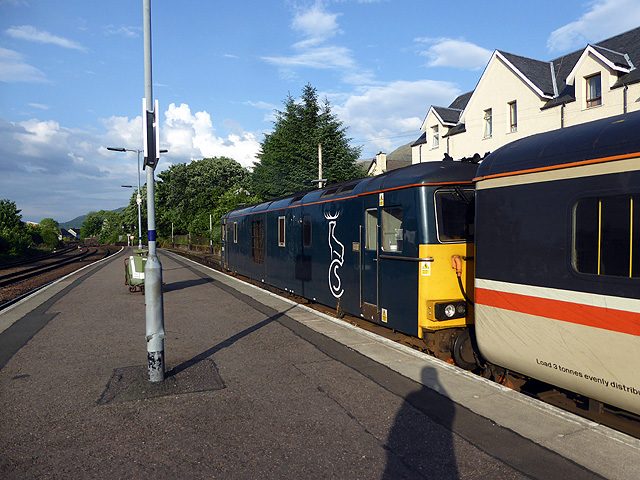
- Fort William railway station, where the Jacobite steam train to Mallaig begins — John Lucas, CC BY-SA 2.0, via Wikimedia Commons
- White sand and clear water at Camusdarach on the coast west of Glenfinnan — Richard Webb, CC BY-SA 2.0, via Wikimedia Commons